Yext is one of the most recognized platforms for managing business listings across the web. It syncs your business information to 200+ directories, manages reviews, and builds local landing pages from a single dashboard.
But here’s the problem,
Many businesses sign up for Yext and eventually hit the same frustrations, high annual costs, listings that revert to old data after cancellation, and an interface that feels built for enterprise teams, not small business owners or lean agencies.
Yext’s pricing starts at around $199/year per location for a basic plan and can climb to $999/year for the premium tier. For multi-location brands, bundled packages often land between $2,500 and $6,000 per location annually. And those are locked into annual contracts.
On top of that, Yext uses a sync-based model. Your listings stay accurate only while you keep paying. Cancel your subscription, and directories can revert to outdated phone numbers, wrong addresses, or old business hours. That’s a dealbreaker for many small and mid-size businesses watching their budgets.
So what’s the alternative?
In this guide, you’ll find 10 Yext alternatives compared side by side. For each tool, we cover:
- What it does best
- Actual pricing
- Key features and limitations
- What type of business it fits
This blog is for business owners, local SEO professionals, and agency teams who want a clear, unbiased comparison. No single tool is pushed as the “winner.” The right choice depends on your business size, budget, and what you actually need from a local listing and reputation management platform.
Why Businesses Switch Away from Yext

Yext is not a bad product. For large enterprises managing hundreds of locations, it remains one of the most complete listing management platforms available. But for many businesses, the friction points stack up over time.
Here are the most common reasons teams start looking for a Yext alternative.
Listing Reversion After Cancellation
Yext uses an API-based sync model called PowerListings. While your subscription is active, Yext pushes your correct business data (name, address, phone number, hours, photos) to 200+ directories through direct integrations. The data stays accurate because Yext continuously syncs it.
But when you cancel, that sync stops. Yext no longer sends your data to publishers. And here’s what happens next: directories fall back to their own data sources, which may include outdated aggregator data, user-submitted edits, or old records.
A case study by Whitespark tracked what happened to 60 Yext-synced listings after a subscription was cancelled. The results were stark: 60% of listings either disappeared or started showing incorrect information. Another 35% were stripped of added details like business descriptions, photos, and hours. Only 5% remained fully accurate, and most of those had been manually claimed before the Yext subscription even started.
Yext’s official position is that they do not actively revert or delete listings when you cancel. That’s technically true. But the practical outcome is the same: without active syncing, your listing data degrades over time as publishers pull from other sources.
For small businesses, this creates a lock-in effect. You pay to keep your listings accurate, and if you stop paying, you may end up worse off than before you signed up.
Pricing That Scales Quickly for Multi-Location Brands

Yext’s pricing is not fully transparent. The company does not publish a clear public price sheet for all plans, and most mid-market or enterprise buyers receive custom quotes after a demo.
Here’s what is known based on published data and third-party analysis:
- Single-location small businesses: Plans start at $199/year (basic) and go up to $999/year (premium). Some reports cite weekly pricing of $10/week (Complete) and $19/week (Premium).
- Mid-market (10-100 locations): Per-location pricing typically ranges from $800 to $2,500/year, depending on the product bundle (Listings, Reviews, Pages) and contract length.
- Enterprise (100+ locations): Custom packaging is standard. Per-location costs can range from $500 to $1,500/year for bundled products, but total annual spend often reaches $50,000 to $200,000+ when you factor in implementation, training, and additional modules.
All plans are billed annually. Multi-year contracts are common and often required to access lower per-location rates. This means a business with just 20 locations on a mid-tier bundle could easily spend $20,000 to $50,000 per year.
Compare that to alternatives like BrightLocal (starting at $39/month), Moz Local ($16/month per location), or Whitespark (one-time fee per location), and the cost gap becomes clear.
For businesses that primarily need Google Business Profile management and basic listing accuracy, paying enterprise-level fees for 200+ directory syncs may not be worth it.
Complex Interface for Small Teams
Yext was built as an enterprise platform, and the interface reflects that.
On G2, “complex usability” is mentioned in 99 user reviews, and “learning curve” appears in 83 reviews. Users consistently report that the platform is feature-rich but overwhelming, especially for teams without dedicated SEO or marketing staff.
Common complaints include:
- Difficult onboarding: Multiple users on Software Advice and Capterra describe the initial setup as confusing, with one reviewer writing that onboarding felt disorganized and the interface was not intuitive.
- Hard to train staff: The number of modules (Listings, Reviews, Pages, Search, Analytics, Social) means team members need time to learn each section separately.
- Navigation challenges: G2’s pros and cons data shows 68 mentions of “difficult navigation,” specifically around filters, criteria, and report building.
- Manual work despite paying for automation: Multiple users report still needing to manually update Google listings even with an active premium subscription, which defeats the purpose of an automated platform.
For a solo business owner or a small agency managing 5-10 clients, this level of complexity adds time and overhead. Simpler tools like BrightLocal, Moz Local, or Synup are often better suited for smaller teams that want results without a steep learning curve.
Limited Review and Reputation Tools
Yext does offer review management features, including monitoring across 80+ sites, AI-assisted response templates, and automated review requests via email, SMS, and QR codes.
But compared to platforms that specialize in reputation management, Yext’s review tools have some gaps.
Here’s where users report limitations:
- CRM integration for review generation: Yext supports review triggers from a limited number of CRMs. The Birdeye comparison page on G2 notes that Yext integrates with roughly 12 CRMs for review generation, while competitors like Birdeye connect with 3,000+ apps.
- Review response customization: Yext caps brand-level review response instructions at 5,000 characters. For multi-location brands with complex compliance or brand voice requirements, this can be restrictive.
- Analytics depth: Several Gartner Peer Insights reviewers mention that Yext’s analytics often surface basic Google data rather than deeper, actionable insights about customer sentiment trends or competitive positioning.
- No built-in messaging or chat: Platforms like Podium and Birdeye include customer messaging, webchat, and even payment tools alongside review management. Yext focuses on listings and reviews, meaning businesses often need additional tools to cover the full customer communication workflow.
If review management and customer engagement are your primary needs, a platform like Birdeye, Podium, or SocialPilot may give you more value per dollar than Yext’s review module.
When Yext Is Still the Right Choice
It’s only fair to acknowledge where Yext still holds a clear advantage. Not every business needs to switch.
Yext may still be the best fit if:
- You manage 100+ locations and need centralized listing governance across 200+ directories with direct API integrations. Yext’s publisher network is one of the largest in the industry.
- You need enterprise-grade compliance controls. Yext offers role-based permissions, audit trails, PHI de-identification for healthcare, and approval workflows that smaller tools don’t match.
- You want a Knowledge Graph architecture. Yext’s proprietary Knowledge Graph acts as a structured database for all your business data, feeding listings, pages, search, and AI experiences. This is more than basic listing syndication.
- You need AI search visibility. Yext’s newer Scout product monitors how your brand appears in AI-generated search results across platforms like Google, ChatGPT, and Perplexity. Few alternatives offer this yet.
- Your industry requires broad directory coverage. If your business relies on niche directories (healthcare, hospitality, financial services), Yext’s deep publisher network gives you coverage that most alternatives cannot replicate.
In short, Yext is still a strong platform for large, complex, multi-location organizations. The issues show up most when smaller businesses or lean teams try to use it for simpler needs at a premium price point.
Top 10 Yext Alternative in 2026
| Sr. No | Tool | Starting Price | Best For | Key Strength | G2/Trustpilot Rating | Listings Ownership |
|---|---|---|---|---|---|---|
| 1 | Citation Forge | $69 one-time (Starter) | Local businesses, SEO agencies, and freelancers needing manual citation building | 100% manual submissions with citation audit, NAP cleanup, and white-label reports | 4.4/5 (Trustpilot) | You own the listings (manually submitted, no subscription) |
| 2 | Birdeye | $299/mo per location | Multi-location review and reputation management | All-in-one CX platform with 3,000+ integrations | 4.8/5 | Sync-based (active subscription required) |
| 3 | BrightLocal | $39/mo (per location) | SMBs and agencies managing local SEO | Local rank tracking, citation building, and white-label reports | 4.6/5 | Hybrid (citations are permanent; Active Sync is subscription-based) |
| 4 | Semrush Local | $30/mo per location (Base); $60/mo per location (Pro with listings) | Teams already using Semrush for SEO | Listing management bundled with a full SEO suite | 4.5/5 (Semrush overall) | Sync-based via directory network |
| 5 | Whitespark | $33/mo (Citation Finder); citation building from $4/citation | Agencies and consultants focused on citation accuracy | Manual citation building with full ownership of listings | 4.6/5 | You own the listings (manually submitted) |
| 6 | Moz Local | $16/mo per location (annual billing) | Single-location SMBs wanting affordable listing management | Simple listing sync to 90+ directories with GeoRank maps | 4.5/5 | Sync-based (listings tied to subscription) |
| 7 | Uberall | Custom pricing (contact sales) | Mid-market to enterprise brands with 10-50+ locations | International coverage, localized pages, and GDPR compliance | 4.3/5 | Sync-based via API integrations |
| 8 | SOCi | Custom pricing ($23K-$62K/year) | Franchise and distributed marketing teams with 50+ locations | AI-powered agents for social, reviews, and local search at scale | 4.5/5 | Sync-based with enterprise governance |
| 9 | Synup | $35/mo per location (Standard) | Agencies needing white-label local marketing tools | Full white-label platform with listings, reviews, and social | 4.5/5 | Listings persist after submission on most directories |
| 10 | Podium | $399/mo (Core plan) | Service businesses focused on lead conversion and messaging | SMS-based reviews, payments, and customer messaging in one platform | 4.6/5 | Not a listing tool (focused on reviews and communication) |
1. Citation Forge (Best for Manual Local Citations Building)
Best For: Local businesses, SEO agencies, and freelancers who want accurate citations built manually without paying monthly platform fees.
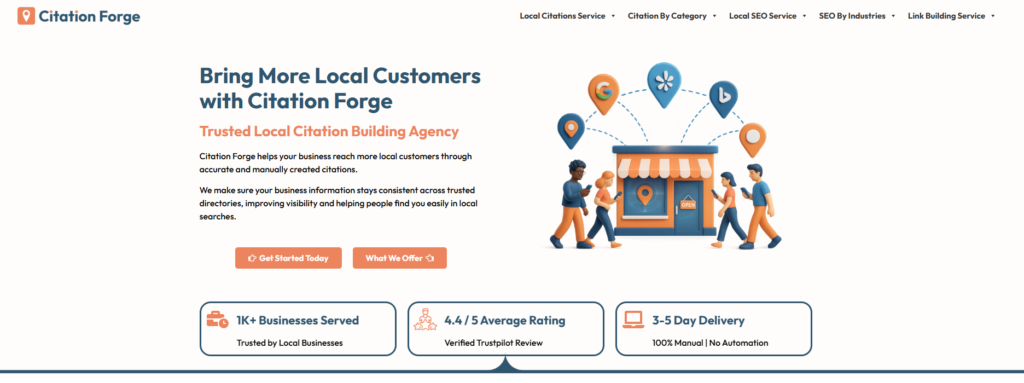
Citation Forge is a manual local citation building service that handles everything from audit to submission to final reporting. They cover top markets including the USA, Australia, Canada, UK, and 50+ other countries. You pay once, they build your listings, and you get a full report with live links when it’s done.
There’s no software. No automation. No recurring subscription. That alone puts it in a different category from Yext and most other tools on this list.
It works well for local businesses, SEO agencies, and freelancers who want clean, consistent directory listings without the ongoing cost of a platform.
What Makes Citation Forge Stand Out
- 100% Manual Submissions: Every listing is built by hand. Citation Forge uses local IP addresses and no automation, so your listings go up accurately and without shortcuts that could cause issues down the line.
- Citation Audit Included: Before they build anything new, they audit your existing citations. They spot duplicates, fix inconsistent NAP data, and clean up bad listings that could be pulling your rankings down.
- NAP Consistency Across All Listings: Your business name, address, and phone number are kept consistent across every directory.
- Niche and Country Targeting: They submit your business to directories that match your industry and location. They cover 50+ countries and a wide range of niches from plumbers and dentists to law firms and IT companies.
- White-Label Reports for Agencies: If you run an SEO agency, you can resell their services under your own brand.
- Rich Media Added to Listings: They upload your logo, photos, business description, and categories to every directory that supports it not just the basic NAP data.
Pricing
Citation Forge uses one-time flat-rate packages with no monthly fees.
| Package | Citations | Price | Per Citation |
|---|---|---|---|
| Starter | 120 | $69 | $0.58 |
| Standard | 200 | $99 | $0.50 |
| Advanced | 300 | $139 | $0.46 |
All packages include manual submission, citation audit, NAP cleanup, image and logo upload, business description writing, duplicate checking, full live report with login details, and delivery within 2–5 business days depending on the plan.
Free Trial: Not available, but no subscription required.
Pros
- One-time payment, no recurring fees
- 100% manual process, no automation
- Citation audit included with every order
- White-label ready for agencies
- Covers 50+ countries and multiple industries
- Full live report with every order
- Fast 2–5 day delivery
Cons
- No DIY option, it’s fully done-for-you
Citation Forge isn’t trying to compete with full-scale listing management platforms. It does one thing building accurate, manual local citations and does it well. If you’re paying $500+/month for Yext just to maintain directory listings, this is a far more budget-friendly way to get the same foundational work done. Rated 4.4/5 on Trustpilot with clients noting fast delivery, clear communication, and clean reports.
2. Birdeye (Best for Multi-Location Review Management)
Best For: Multi-location businesses with 5+ locations that need a unified platform for reviews, listings, social media, and customer communication. Birdeye is especially strong for industries like healthcare, dental, home services, and automotive where review volume directly impacts local search rankings and customer acquisition.
Birdeye is an all-in-one customer experience and reputation management platform built for multi-location businesses. It combines review management, listing sync, social media publishing, messaging, surveys, and referral tools into a single dashboard powered by its BirdAI engine.
Key Features
- Reviews AI: Automated review generation via email, SMS, and QR codes across 200+ review sites. AI-assisted response drafts and sentiment analysis help teams respond faster across all locations.
- Listings AI: Syncs business information across major directories and continuously optimizes listing data for local search visibility.
- Social AI: Schedules and publishes social posts across locations with AI-generated content suggestions.
- Search AI: Monitors how your brand appears in AI-generated search results on Google, ChatGPT, and Perplexity. This is a newer feature that competes directly with Yext’s Scout product.
- Marketing Automation: Runs personalized email and SMS campaigns at the location level.
- Integrations: Connects with 3,000+ apps, including major CRMs like Salesforce, HubSpot, and many industry-specific practice management systems.
- Unified inbox: Manages customer messages from text, webchat, and social channels in one place.
- Payments: Collects payments via text and webchat.
Pricing
Birdeye does not publish fixed prices on its website. Pricing is per location, per month, and varies based on the plan (Starter, Growth, or Dominate) and number of locations.
Based on third-party verified data:
- Starter plan: ~$299/month per location (reviews, listings, messaging)
- Growth plan: ~$349/month per location (adds social media management)
- Dominate plan: ~$449/month per location (adds chatbot AI)
- Multi-location businesses (4+ locations): Custom “Premium” pricing with volume discounts. Per-location costs decrease as you add more locations.
All plans include campaigns, team chat, payments, integrations, mobile app, unlimited users, and unlimited contacts. A 30-day free trial is available for limited features.
Pros
- One of the most complete platforms for managing reviews, listings, social, and messaging from a single dashboard
- Strong AI capabilities for review responses and content generation (BirdAI)
- 3,000+ integrations, far more than Yext’s integration ecosystem
- Industry-specific solutions for healthcare, automotive, real estate, restaurants, and more
- Google Partnership for direct GBP optimization
- Unlimited users and contacts on all plans
Cons
- Expensive for small businesses, especially those with fewer than 5 locations
- Per-location pricing adds up fast (5 locations on the Growth plan = ~$1,995/month)
- Annual contracts are common, and some users report difficulty cancelling
- Listings are sync-based, meaning they require an active subscription to stay accurate
- The platform can feel overwhelming for teams that only need basic review management
3. BrightLocal (Best for SMBs and Agencies on a Budget)
Best For: Small businesses with 1-10 locations that want an affordable local SEO toolkit, and agencies managing multiple clients that need white-label reports, citation building, and local rank tracking. BrightLocal is the strongest option for teams that want local SEO fundamentals (rankings, citations, reviews) without paying for features they don’t use, like social media or messaging. It’s also ideal for consultants who need a strong free trial to evaluate the platform before committing.
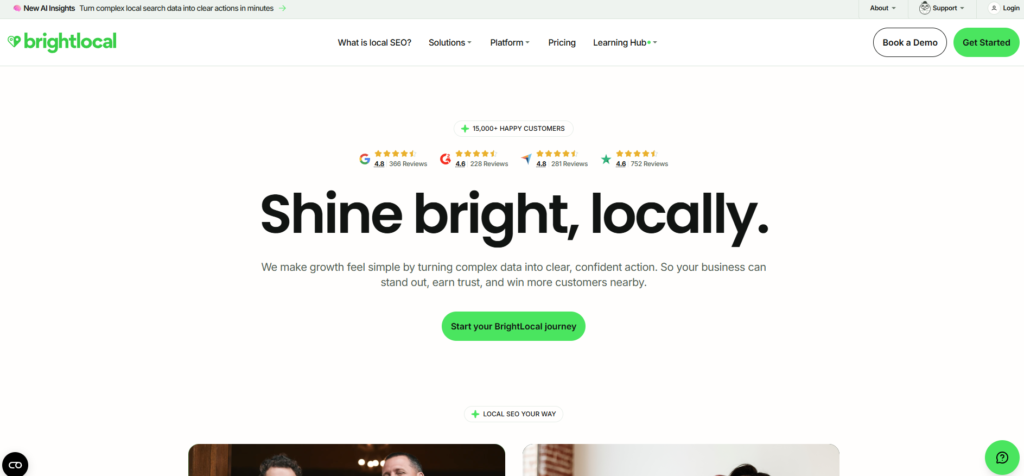
BrightLocal is a dedicated local SEO platform that helps small businesses and agencies track local rankings, manage listings, build citations, and monitor online reviews. It’s one of the most widely used tools in the local SEO space, trusted by over 15,000 businesses and agencies since 2009.
Key Features
- Local Search Grid: Visualizes how your business ranks across a geographic grid of map locations. This is one of BrightLocal’s standout features for tracking Google Business Profile performance at the neighborhood level.
- Local Rank Tracker: Monitors keyword rankings in local search results across Google, Bing, and Google Maps with regular updates.
- Local Search Audit: Runs a comprehensive audit across 300+ data points covering your GBP, citations, on-site SEO, and competitor positioning.
- Listings Management: Keeps business information accurate across Google, Apple, and other directories. Uses Active Sync (subscription-based) to suppress third-party edits and schedule GBP posts.
- Citation Builder: A pay-as-you-go service that manually submits your business to directories and data aggregators (Data Axle, Neustar Localeze, Foursquare, Yellow Pages Network, GPS Network). Citations built this way are permanent, meaning they stay even if you cancel.
- Reputation Manager: Monitors reviews across Google, Yelp, Facebook, and other platforms. Includes review response, review generation campaigns, sentiment tracking, and a reviews widget for your website. Available only on the Grow plan.
- AI Insights (new): Turns local SEO data into prioritized action recommendations. This is part of BrightLocal’s platform evolution currently rolling out.
- White-label reports: Customizable, branded reports for agencies to send to clients. Available on the Grow plan.
- Free local SEO tools: Includes a free local search audit, GBP audit, and review checker with no account needed.
Pricing
BrightLocal publishes clear pricing on its website. All plans are priced per location, with discounts for annual billing (25% savings). A 14-day free trial is available with no credit card required.
- Track plan: $39/month per location (monthly) | Rankings, audits, competitor insights, GBP and website performance monitoring
- Manage plan: $49/month per location (monthly) | Everything in Track + listings sync to Google and Apple, edit suppression, GBP post scheduling
- Grow plan: $59/month per location (monthly) | Everything in Manage + review monitoring, review generation, review response, reviews widget, white-label reports
- Annual billing: 25% discount across all plans (Track $29/mo, Manage $39/mo, Grow $49/mo per location)
- Citation Builder: Pay-as-you-go, starting at $3.20 per site (or $2 per site with bulk credits). No subscription required. Accessible from any plan, including a free account.
- Active Sync: $50 per location per year for listing sync across directories
- Managed Local SEO Services: Fully done-for-you local SEO by BrightLocal’s expert team, custom-quoted from $799 to $1,299/month per location
- Enterprise/custom plans: Available for businesses managing 50+ locations
Pros
- Transparent, affordable pricing with no hidden fees
- 14-day free trial with no credit card required
- Citation Builder creates permanent listings that stay even after cancellation
- Local Search Grid is one of the best GBP rank tracking features available
- Strong white-label reporting for agencies on the Grow plan
- Free local SEO tools available without any account
- Platform operates in USA, UK, Canada, and Australia
- BrightLocal Academy offers free courses to build local SEO skills
Cons
- Review management is only available on the Grow plan ($59/month per location), not on lower tiers
- Citation Builder costs extra on top of the subscription (pay-as-you-go credits)
- Active Sync for listings is a separate annual fee ($50/location/year)
- No social media management module
- Platform can struggle to scale smoothly past 50 locations (enterprise plans are custom-quoted)
- Some users report the credit-based pricing for citations can make total costs harder to predict
4. Semrush Local (Best for Teams Already Using an SEO Suite)
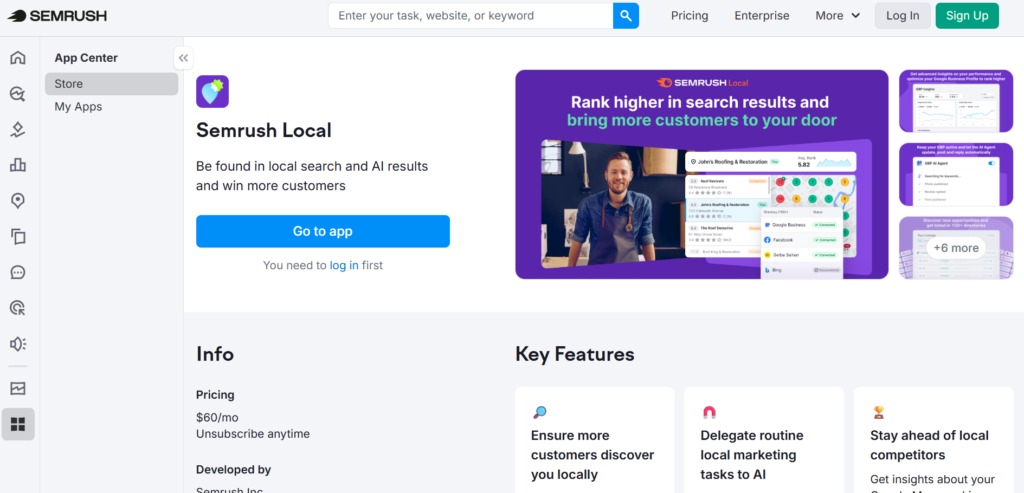
Best For: Marketing teams and agencies that already use Semrush for SEO and want to add local capabilities without switching platforms. Semrush Local is ideal for businesses that treat local SEO as one part of a broader organic search strategy and want keyword research, rank tracking, backlink data, and local listing management under one login. It’s a strong fit for teams managing 1-20 locations that want GBP automation and competitive intelligence built in.
Semrush Local is a local SEO add-on within the broader Semrush platform. It combines Google Business Profile management, listing distribution, review monitoring, and map rank tracking into one toolkit that sits alongside Semrush’s keyword research, site audit, backlink analysis, and content marketing tools. If your team already uses Semrush for traditional SEO, adding Local avoids the need for a separate platform.
Key Features
- GBP AI Agent: Automatically audits your Google Business Profile, generates and publishes posts, replies to reviews in your chosen tone, posts photos at an optimal frequency, and optimizes your business description with relevant keywords. This runs on autopilot once configured.
- Map Rank Tracker: Uses a GEO grid to show exactly where your business ranks on Google Maps across multiple geographic points. The Base plan includes 375 credits; the Pro plan includes 1,225 credits.
- Listing Management (Pro plan only): Distributes your business data to 70+ directories with one click. Includes healthcare-specific directories in the US (WebMD, Vitals, Wellness.com). Also handles duplicate suppression and user suggestion management.
- Review Management (Pro plan only): Centralizes reviews from popular review sites into one dashboard. Includes negative review alerts, hourly GBP review updates, automated review generation campaigns via SMS or email, and AI-powered review reply drafts.
- Competitor review analytics: Tracks competitors’ review progress and customer sentiment. Available with up to 10 reports per month on the Pro plan.
- Advanced GBP tools (Pro plan only): Historical GBP insights not available in the native GBP interface, AI-assisted post creation, edit/suggestion monitoring to protect your profile from unwanted changes, bulk GBP connect and edit for multi-location teams, location grouping, and team collaboration features.
- Listing Management API: Integrates listing data with external tools and workflows for custom reporting.
- Full Semrush SEO suite access: When paired with a Semrush subscription (Pro, Guru, or Business), you get keyword research, site audit, rank tracking, backlink analytics, content tools, and competitive intelligence alongside your local SEO data.
Pricing
Semrush Local is priced per location, per month. It can be added to an existing Semrush subscription or purchased as a standalone product.
- Local Base: $30/month per location. Includes the GBP AI Agent (automated posts, review replies, photo publishing, description optimization) and Map Rank Tracker with 375 credits.
- Local Pro: $60/month per location. Includes everything in Base plus listing management across 70+ directories, review management and generation, advanced GBP tools, competitor analytics, bulk editing, team collaboration, and 1,225 Map Rank Tracker credits.
- Local Business: Custom pricing for businesses with 20+ locations. Contact Semrush sales for a quote.
- Semrush core subscriptions (separate): Pro at $139.95/month, Guru at $249.95/month, Business at $499.95/month. These are required for full SEO suite access but not required to use Semrush Local as a standalone.
Pros
- If you already pay for Semrush, adding Local consolidates your tools and avoids duplicate subscriptions
- GBP AI Agent automates post creation, review responses, and profile optimization with minimal manual effort
- Map Rank Tracker with GEO grid is one of the best local ranking visualization tools available
- Listing distribution to 70+ directories on the Pro plan, including US healthcare directories
- Competitor review analytics provides a clear picture of how your reputation stacks up
- Full integration with Semrush’s keyword research, site audit, and backlink tools means your local and organic SEO strategies share one data source
Cons
- Listing management and review tools are only available on the Pro plan ($60/month per location), not on the Base plan
- Local is priced per location on top of your existing Semrush subscription, so total costs add up quickly (e.g., Semrush Guru + 10 locations on Pro = $249.95 + $600 = $850/month)
- Directory coverage (70+) is smaller than Yext’s 200+ publisher network
- No citation building service (unlike BrightLocal or Whitespark)
- Listings are sync-based, meaning they depend on an active subscription
- The standalone Local product gives you local tools only, without Semrush’s broader SEO suite
- No white-label reporting within Semrush Local itself (available in core Semrush plans)
5. Whitespark (Best for One-Time Citation Building Without Recurring Fees)
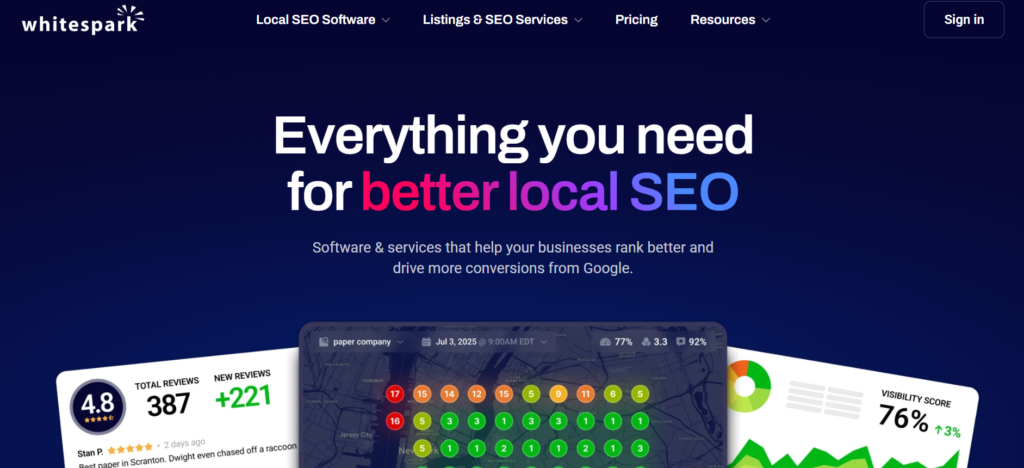
Best For: Businesses and agencies that want to permanently own their listings without paying recurring fees. Whitespark is the strongest choice for anyone actively leaving Yext, thanks to its dedicated Yext Replacement Service. It’s also ideal for SEO consultants and agencies that prefer manual, high-quality citation building over automated sync, and for teams that want to pick and pay for only the specific local SEO tools they need rather than buying an all-in-one bundle they won’t fully use.
Whitespark is a local SEO company that sells its software tools and services individually rather than as a forced bundle. It’s best known for manual citation building, local rank tracking, and its annual Local Search Ranking Factors survey, which is widely cited across the SEO industry. Whitespark also offers a dedicated Yext Replacement Service designed specifically for businesses leaving Yext.
Key Features
- Local Platform: Manages Google Business Profiles with tools to prevent unwanted updates, edit locations in bulk, and monitor profile changes. Priced at just $1/month per location.
- Local Ranking Grids: Tracks local rankings across up to 225 geographic points using a visual grid format. Plans start at $10/month with enterprise pricing available.
- Local Rank Tracker: Monitors local and organic search performance with ranking data for Google, Google Maps, and Bing. Plans range from $14/month to $200/month depending on the number of locations and keywords tracked.
- Local Citation Finder: Identifies where competitors are listed, tracks your existing citations, and finds new citation opportunities. Plans range from $33/month to $149/month.
- Reputation Builder: Automates review requests and manages online reviews. Priced at $79/month per location, with custom multi-location pricing available.
- Listings Service (done-for-you): Whitespark’s team manually audits, cleans up, and builds citations on the most important directories. This is a one-time fee service, not a subscription. Packages range from $20 to $999 depending on scope.
- Yext Replacement Service: A one-time $399 per location service designed specifically for businesses cancelling Yext. The team performs a comprehensive NAP audit, cleans up listings that degraded after cancellation, builds new citations on 42+ directories (including industry and city-specific sites), and provides a detailed report with login credentials for every listing. You own all the listings permanently.
- GBP Reinstatement Service: Helps businesses get a suspended Google Business Profile reinstated.
- Enterprise Services: Custom solutions for multi-location businesses.
- Free tools: Review Checker, Google Review Link Generator, Free Local Ranking Checker, and Freshness Distance Calculator.
Pricing
Whitespark uses an à la carte pricing model. You buy only what you need.
Software (monthly subscriptions):
- Local Platform: $1/month per location
- Local Ranking Grids: Starting at $10/month
- Local Rank Tracker: $14/month to $200/month
- Local Citation Finder: $33/month to $149/month
- Reputation Builder: $79/month per location
Services (one-time fees):
- Listings Service (citation building and cleanup): $20 to $999 per location (one-time)
- Yext Replacement Service: $399 per location (one-time)
- SEO Services (done-for-you): $499/month to $1,399/month
Annual billing is available for software products with 20% savings.
Pros
- You own every listing Whitespark builds. No subscription lock-in, no listing reversion. This is the exact opposite of Yext’s sync model.
- The Yext Replacement Service at $399 (one-time) is specifically designed for businesses switching from Yext, including cleanup of listings that degraded after cancellation
- À la carte pricing means you only pay for the tools you actually use
- Manual citation work is done by Whitespark’s in-house team, not automated bots, which tends to produce higher-quality listings
- Founded in 2005 with over 100,000 customers, and known for publishing the annual Local Search Ranking Factors report, giving them deep credibility in the local SEO space
- Local Platform at $1/month per location for GBP management is one of the most affordable options available
- Free tools provide quick value without any purchase
Cons
- No all-in-one platform. If you need rank tracking, citation building, review management, and GBP management, you’ll pay for multiple separate products
- Manual citation building takes longer than automated sync (listings may take days to months to go live)
- No listing sync or Active Sync feature. If your business information changes frequently, you’ll need to pay for updates
- Reputation Builder at $79/month per location is expensive compared to review tools from BrightLocal or Semrush
- No social media management tools
- No AI search visibility monitoring (like Yext Scout or Birdeye Search AI)
- Interface, while improved, is not as polished as newer platforms like Synup or Birdeye
6. Moz Local (Best for Simple, Affordable Listing Management)
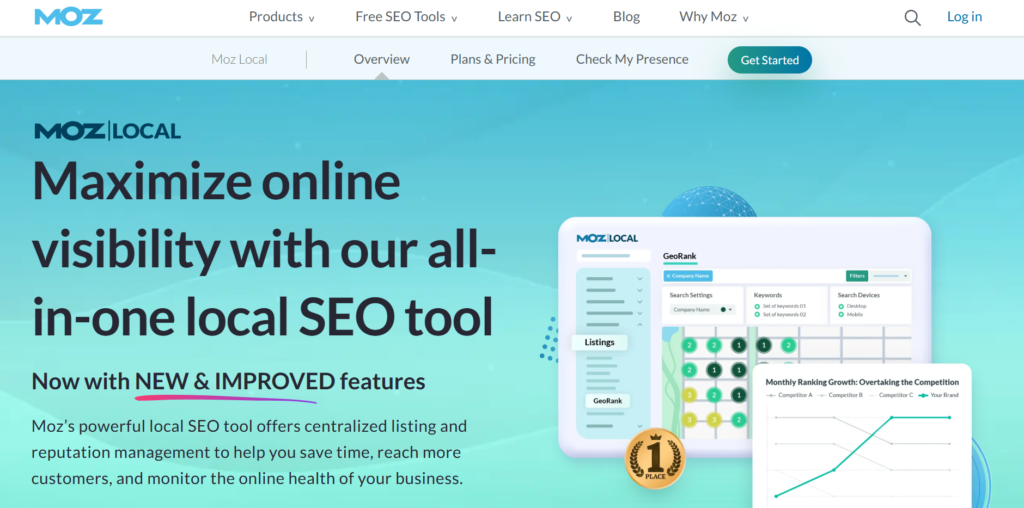
Best For: Single-location small businesses and small multi-location brands (1-15 locations) in the US, UK, or Canada that want the simplest, most affordable way to keep their listings accurate across 90+ directories. Moz Local is ideal for businesses that don’t need advanced features like CRM integrations, customer messaging, or social media management, and just want their NAP data correct everywhere with minimal effort. It’s also a strong fit for agencies that want to mark up per-location pricing to clients while keeping their own costs low.
Moz Local is a local presence management platform that automates listing distribution across 90+ directories, monitors reviews, and tracks local map rankings from a single dashboard. It’s one of the most affordable per-location tools in this category and is built for small businesses that want a straightforward, low-maintenance way to keep their business information accurate across the web.
Key Features
- Automated listing distribution: Syncs your business name, address, phone number, hours, photos, and descriptions to 90+ directories including Google, Facebook, Apple Maps, Bing, Yelp, and Waze. Changes made in the Moz Local dashboard push to all connected directories automatically.
- GeoRank tracking: Interactive heatmaps that show exactly where your business ranks in Google’s local map pack results across different neighborhoods and geographic points. Included on all plans, not just premium tiers.
- Review monitoring: Centralizes reviews from all major networks into one dashboard so you can track new feedback without logging into each platform separately. Available on all plans.
- Review responding (Preferred and Elite): Respond to Google and Facebook reviews directly from the Moz Local dashboard. The Preferred plan adds review generation campaigns and sentiment analysis.
- Social posting (Preferred and Elite): Schedule and publish posts to Google and Facebook from within the platform. The Elite plan extends social posting to Instagram, LinkedIn, and TikTok, and adds Facebook ad boosting and social inbox responding.
- Listings AI (add-on or included in Elite): Uses AI to rewrite and optimize your business profiles across directories with unique, keyword-rich descriptions tailored to each platform’s format. Also suggests category changes, photo improvements, and attribute additions.
- Reviews AI (add-on): Generates AI-powered reply drafts for reviews. Available as a $10/month or $69/year add-on.
- Data Health analytics: Tracks the accuracy and consistency of your listing data across platforms and flags inconsistencies.
- Google Q&A management: Monitors and manages questions posted on your Google Business Profile. Included on all plans.
- Competitor analysis (Preferred and Elite): Compares your local presence against competitors.
- Agency permissions (Preferred and Elite): Role-based access controls for teams managing client accounts.
- Enterprise plan: Custom pricing for businesses with 50+ locations, including dedicated support, custom integrations, and priority SLAs.
Pricing
Moz Local is priced per location with three self-serve plans plus a custom enterprise tier. Both monthly and annual billing are available, with annual billing saving up to 20%.
- Lite: $20/month per location ($16/month billed annually at $199/year). Listing distribution to 90+ directories, GeoRank maps, review monitoring, Data Health analytics, Google Q&A management.
- Preferred: $30/month per location ($24/month billed annually at $299/year). Everything in Lite plus review responding, review generation, sentiment analysis, social posting to Google and Facebook, content libraries, competitor analysis, and agency permissions.
- Elite: $40/month per location ($33/month billed annually at $399/year). Everything in Preferred plus Listings AI add-on included, social posting to Instagram/LinkedIn/TikTok, Facebook ad boosting, social inbox responding, and a full reporting suite for leads, reviews, and social.
- Enterprise: Custom pricing for 50+ locations. Includes dedicated support, custom integrations, guaranteed SLAs, and priority response times.
- Add-ons: Listings AI at $14/month or $119/year (included free in Elite). Reviews AI at $10/month or $69/year.
Moz Local does not offer a traditional free trial, but a free citation checker is available to audit your listings across major directories before purchasing.
Pros
- One of the most affordable per-location listing management tools available (starting at just $16/month annually)
- GeoRank heatmaps included on all plans, giving every user geographic ranking intelligence
- Simple, clean interface that requires minimal setup (approximately 15 minutes per location)
- Listing changes push to 90+ directories automatically, saving hours of manual work
- Listings AI generates unique, optimized descriptions per directory rather than copying the same text everywhere
- Google Q&A management included on all plans, which most competitors charge extra for
- Available in the USA, UK, and Canada
- Moz Local is a standalone product, so you don’t need a Moz Pro subscription to use it
Cons
- Listings are sync-based. If you cancel, directories may revert to old data over time (same model as Yext, just at a lower price)
- Review responding and social posting are locked behind the Preferred plan ($24/month annually), not available on Lite
- 90+ directories is solid but fewer than Yext’s 200+ publisher network
- No citation building service (unlike BrightLocal or Whitespark). Moz Local syncs, but does not manually submit to niche or city-specific directories
- Listing updates can take days to weeks to fully propagate across some directories
- Limited to the US, UK, and Canadian markets. Not suitable for businesses that need international directory coverage
- Some users on G2 and Capterra report slow support response times and confusing invoicing
7. Uberall (Best for International Multi-Location Brands)
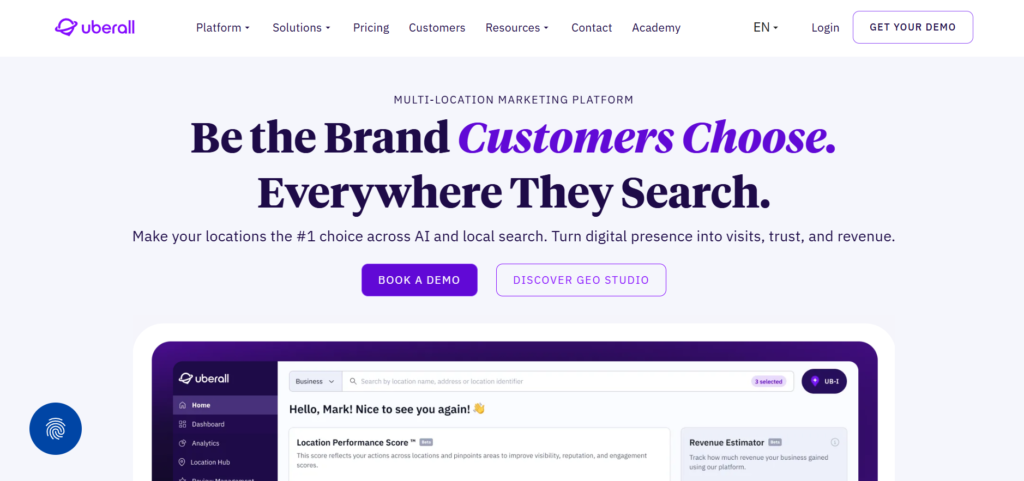
Best For: Mid-market to enterprise brands managing 10-500+ locations, especially those with international operations across Europe and North America. Uberall is the strongest Yext alternative for businesses that need broad directory coverage (150+ sites), localized landing pages, and AI search visibility monitoring in a single platform. It’s particularly well-suited for retail chains, restaurant groups, healthcare networks, and automotive brands with locations across multiple countries that need GDPR-compliant listing and reputation management at scale.
Uberall is a location marketing platform built for multi-location brands that need to manage listings, reviews, social media, and local pages across international markets. Founded in Berlin in 2013, it powers over 1.3 million locations globally and is particularly strong in European markets where GDPR compliance and regional directory coverage matter. Uberall positions itself between Yext’s enterprise complexity and budget tools’ limitations.
Key Features
- Listings Management: Syncs business information across 150+ directories, including Google, Apple Maps, Yelp, Bing, and AI search engines. Includes duplicate suppression, keyword recommendations, publisher and user suggestion management, profile protection, voice network optimization, and OAuth connections.
- Location Data Management: Centralized system to manage address, phone, hours, photos, and videos across all locations. Supports bulk data editing, scheduled location updates, and unlimited users.
- GEO Studio (add-on): Tracks your brand’s share of voice in AI search results, provides competitive benchmarking against other brands in AI-generated responses, identifies strategic visibility gaps, and enables multi-channel content distribution. This directly competes with Yext’s Scout product.
- Review Management (Stand Out and Connect plans): Unified inbox for all reviews, AI-powered review responses with bulk reply capability, automated response rules, review generation via email and bulk QR codes, response library with dynamic localization fields, sentiment analysis, and email/push notification alerts.
- Local Social Media Management (Connect plan): Posting and comment management on Facebook, Instagram, and Google (including Google Q&A). Includes an AI Social Writer for generating localized content, content libraries, and a social media publishing calendar.
- Locator and Local Pages (add-on): Custom-designed, SEO-optimized store locator and location-specific landing pages hosted on your domain. No-code setup with image optimization and analytics.
- Social Ads (add-on): Localized Facebook and Instagram ad campaigns with geolocation targeting, A/B testing, and reporting.
- AI-Powered Chatbot and Message Assistant: Automated customer messaging across locations.
- Insights and Analytics: Local Performance Score (LPS), personalized optimization recommendations, location benchmarking, and dedicated reports for Google, Apple, and listings.
- Mobile App: Manage locations, respond to reviews, and monitor performance on the go.
- Industry solutions: Dedicated solutions for retail/franchise, food and beverage, automotive, finance/insurance, healthcare, EV charging stations, and service area businesses.
Pricing
Uberall does not publish fixed dollar amounts on its website. Pricing is custom-quoted based on the number of locations, plan tier, and add-ons selected. The platform offers three main plans:
- Show Up: Uberall Essentials (location data management, insights, analytics, mobile app, support) + Listings. Optional add-ons: Posting to Google and Apple, Analytics Plus, Collaborate Plus.
- Stand Out (most popular): Everything in Show Up + Reviews (AI responses, automated responses, review generation, sentiment analysis). Optional add-ons: Posting to Google and Apple, Reviews Plus, Analytics Plus, Collaborate Plus.
- Connect: Everything in Stand Out + Local Social (posting to Facebook, Instagram, and Google, AI Social Writer, content libraries) + Posting to Google and Apple included. Optional add-ons: Reviews Plus, Analytics Plus, Collaborate Plus.
Additional add-ons available across plans: Locator and Local Pages, GEO Studio, Social Ads.
Based on third-party data and G2 reviews, Uberall is typically positioned as an enterprise-level platform with pricing comparable to or slightly below Yext. Exact costs require contacting their sales team. No free trial or free plan is available, but a free listings audit tool is accessible on their website.
Pros
- 150+ directory integrations, larger than Moz Local (90+), BrightLocal, or Semrush (70+) and closer to Yext’s coverage
- Strong international and European market support with GDPR compliance built in
- GEO Studio for AI search visibility tracking is a direct competitor to Yext’s Scout, making Uberall one of the few alternatives that addresses AI search
- Localized landing pages and store locator hosted on your own domain (SEO-friendly)
- AI-powered review responses with bulk reply and sentiment analysis reduce manual workload at scale
- Dedicated industry solutions for retail, food, automotive, healthcare, and finance
- Available in multiple languages (English, German, French, Italian, Spanish)
- Trusted by recognizable brands like Pret A Manger, with 1,000+ marketing teams using the platform
Cons
- No public pricing. You must contact sales for a quote, which adds friction to the evaluation process
- No free trial available
- Pricing is enterprise-level, making it too expensive for small businesses or single-location operations
- Some G2 and Gartner reviewers report that listing sync does not always reflect correctly on Google, requiring manual follow-up
- Navigation can feel overcomplicated with too many menus and submenus, according to multiple user reviews
- Not a partner-first platform. Lacks white-label capabilities and agency-specific features that tools like Synup or BrightLocal provide
- No managed services offering for businesses that want a done-for-you solution
- Listings are sync-based, so cancelling means data may degrade over time
8. SOCi (Best for Franchise and Distributed Marketing Teams)
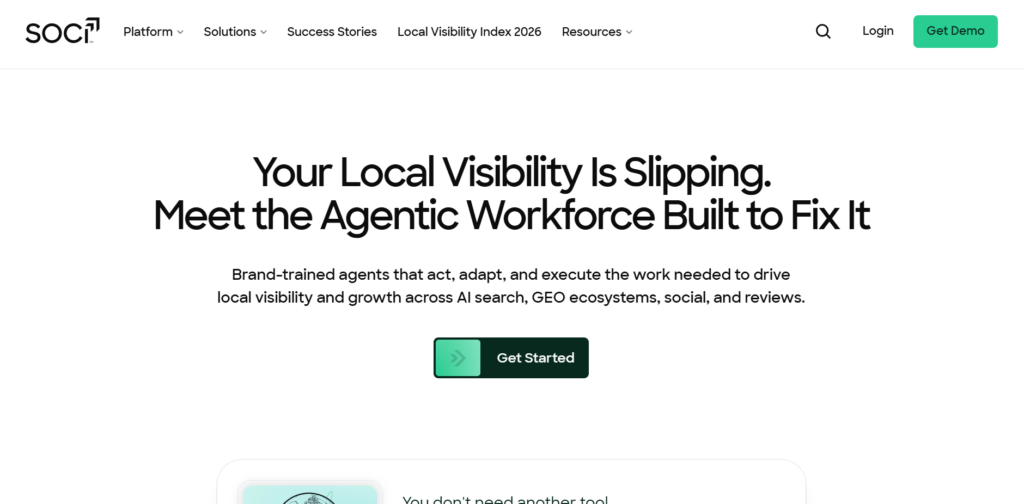
Best For: Franchise brands and large distributed enterprises with 50-5,000+ locations that need an AI-powered platform to handle local search, social media, and reputation management autonomously across every location. SOCi is the strongest fit for organizations where corporate marketing teams set the brand guidelines and strategy, but individual locations need automated, localized execution without dedicated on-site marketing staff. It’s ideal for industries like franchise restaurants, financial services, property management, retail chains, and healthcare networks where consistent brand governance at scale is a top priority.
SOCi is an AI-powered multi-location marketing platform built specifically for franchise brands, distributed enterprises, and organizations where a corporate team needs to coordinate marketing across hundreds or thousands of individual locations. Its core differentiator is the “Genius Agents” system, a set of brand-trained AI agents that autonomously handle local search optimization, social media, and review management across every location without requiring manual work from each franchisee or location manager.
Key Features
- Genius Local Search Agent: Analyzes data at each location monthly, recommends changes to listings and local pages, and automates optimizations for local search and AI search visibility. Handles listing management, GBP optimization, and publishes Google Posts automatically.
- Genius Social Agent: Automatically builds a social content calendar for each location, creates and publishes posts to Facebook, Instagram, and Google, and responds to social engagements. Content is brand-guided but localized for each market.
- Genius Reputation Agent: Responds to all reviews across locations using AI trained on your brand’s voice and guidelines. Analyzes survey responses, tracks customer sentiment trends, and surfaces reputation insights at scale.
- Local Pages: Creates customizable, SEO-optimized landing pages for each location to maximize search visibility and drive conversions.
- Locators: SEO-friendly store locator pages that help customers find nearby locations and products.
- Ads and Boost: Auto-generates and deploys hyper-localized ad campaigns across Facebook and Instagram, tailored to each location’s audience. Includes boosted posts for scaling top-performing organic content.
- Surveys: Collects and analyzes structured customer feedback to complement review data and uncover operational insights.
- Chatbots: Deploys localized chatbots across Facebook Messenger and Google Business Messages at scale for 24/7 customer support and lead generation.
- Integrations: Connects with existing marketing, CRM, and operations tools.
- Industry solutions: Purpose-built workflows for financial services, restaurants, franchise, property management, retail, and healthcare.
- SOCi U: Built-in training university for onboarding teams and location managers.
- Partner programs: Reseller and referral programs for agencies.
Pricing
SOCi does not publish pricing on its website or on G2. All pricing is custom-quoted based on the number of locations, selected products, and contract terms.
Based on third-party analysis:
- Typical annual spend: $23,000 to $62,000/year depending on the number of locations and product suite selected
- Minimum entry point: Approximately $20,000+/year, making SOCi impractical for small businesses
- Per-location costs decrease as total location count increases (volume discounts are standard)
No free trial or free plan is available. SOCi offers demos and product tours on their website.
Pros
- The Genius Agents system is the most advanced “autonomous AI workforce” approach in the local marketing category. Agents work 24/7, share insights across search/social/reputation, and act on your brand guidelines without manual input
- Purpose-built for franchise and distributed enterprise structures where corporate teams need centralized control with localized execution
- Covers the full marketing stack (search, social, reputation, ads, pages, locators, surveys, chatbots) in a single platform
- Recognized by Fast Company as one of the World’s Most Innovative Companies
- Trusted by major brands like Ford, Ace Hardware, and Liberty Tax
- Strong compliance and governance features for brands that need approval workflows and brand-consistency controls across locations
- SOCi U training platform helps onboard location managers without burdening the corporate marketing team
Cons
- No public pricing and a high minimum annual spend (~$20K+/year) make it inaccessible for small and mid-size businesses
- No free trial to evaluate the platform before committing
- Learning curve for beginners, with multiple G2 and Capterra reviewers noting the interface takes time to learn
- No TikTok or YouTube scheduling support as of current feature set
- Some users report limitations with video and carousel post formatting
- Batch content processing can be slow when managing large volumes
- Not suitable for single-location businesses or small agencies managing a handful of clients
9. Synup (Best White-Label Platform for Agencies)
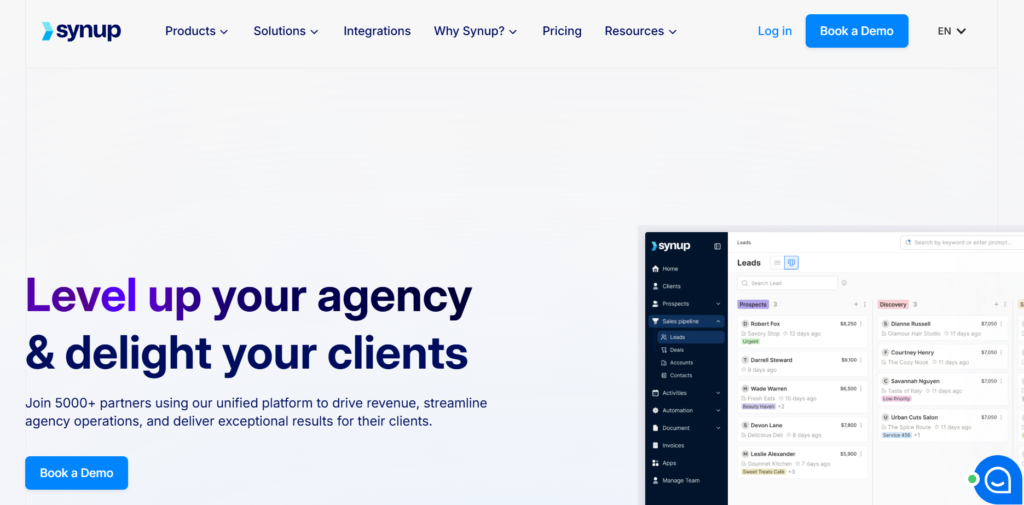
Best For: Marketing agencies of all sizes that want a unified platform to manage clients, sell services, deliver local SEO results, and retain clients, all under their own brand. Synup is the strongest choice for agencies that need white-label capabilities, built-in sales and billing tools, and a scalable operating system that grows as their client count increases. It’s particularly well-suited for SEO agencies, web design agencies, advertising agencies, and vertical SaaS companies that want to offer local marketing services to SMB clients without cobbling together multiple separate tools.
Synup is a white-label local marketing operating system designed specifically for agencies. Unlike most tools in this list that are built for end businesses, Synup is built for agencies that manage local SEO, reputation, and social media for their SMB clients. It includes a full agency operating system (Synup OS) with client management, sales pipeline, invoicing, proposals, and churn forecasting alongside the core marketing tools (listings, reviews, social, SEO).
Key Features
- Synup OS (Agency Operating System): A complete agency management platform that includes CRM, sales pipeline management, lead generation, client accounts, team management, invoicing, e-sign, proposals, contract templates, and subscription billing. This is what sets Synup apart from every other tool on this list.
- White-label everything: Fully white-labeled client dashboard, emails sent from your own domain with your branding, embeddable tools for your website, and customizable app design (logo, colors, look and feel). No mention of Synup anywhere your clients can see.
- Listings Management: Manages business listings across directories including Google, Bing, and Facebook. The Startup plan includes 10 core sites. The Listings Pro add-on extends coverage to a broader directory network with data aggregator submissions, duplicate suppression, voice search optimization, and listing analytics.
- Review Management: Monitors reviews across platforms, generates review requests via email and SMS, provides AI-powered review response suggestions, and includes sentiment analysis. Included in all OS plans.
- Social Media Management: Schedules and publishes posts across Facebook, Instagram, LinkedIn, and X (Twitter). Includes AI-powered content generation, content suggestions based on trends, and engagement tracking.
- SEO tools: Keyword rank tracking, grid rank tracking for local map results, and SEO reporting.
- Lead generation: Monthly lead credits for prospecting SMB clients, lead gen forms, prospecting reports, and email sequences for outreach.
- Client portal: A self-serve dashboard where your clients can view their own data and reports without needing to contact your team.
- Churn forecasting: AI-driven client health scores and usage insights to predict which clients are at risk of leaving.
- Managed migration: Synup offers migration support for agencies switching from other platforms.
- Contract buy-outs: Synup will buy out your existing contract with a competing tool to remove switching friction.
- Joy Assist: Built-in generative AI email writer for client communication.
- Available in 4 languages: English, German, French, Spanish.
Pricing
Synup publishes clear pricing on its website. Plans are structured as agency-level subscriptions (not per-location pricing for the OS itself), with add-ons for expanded listing and social features.
Synup OS plans:
- Startup: $79/month (annual) | $99/month (monthly). Up to 5 team members, 25 client accounts, 50 client users, 25 locations for listings and reviews, 50 monthly lead credits, 25 prospecting reports.
- Agency: $199/month (annual) | $249/month (monthly). Up to 10 team members, 100 client accounts, unlimited client users, 100 locations for listings and reviews, 100 monthly lead credits, 100 prospecting reports. Adds white-labeled client dashboard, customizable app design, and embed capabilities.
- Scale: $799/month (annual) | $999/month (monthly). Up to 50 team members, 500 client accounts, unlimited client users, 500 locations for listings and reviews, 500 monthly lead credits. Adds API access, SSO/SAML, and SKU Manager for controlling which services each client sees.
Add-on costs:
- Additional team members: $5/month each
- Additional client accounts: $1.50/month each
- Listings Pro (expanded directory network): Additional pricing per location
- Social management: Available as an add-on to OS plans
Annual billing saves 20% across all plans.
Pros
- The only tool in this list built as a complete agency operating system, not just a marketing tool
- Full white-label capability, including dashboard, emails, and embeddable modules. No other tool in this comparison matches this level of agency branding
- Transparent, published pricing with no hidden fees
- Contract buy-out program removes the financial barrier to switching from a competitor
- Managed migration support reduces the effort of switching platforms
- Churn forecasting with AI-driven client health scores is a unique feature no other listing management tool offers
- Built-in sales pipeline, invoicing, proposals, and e-sign eliminate the need for separate agency management software
- Available in English, German, French, and Spanish
Cons
- The Startup plan’s listings are limited to 10 core directories (Google, Bing, Facebook). Broader directory coverage requires the Listings Pro add-on at additional cost
- Not designed for end businesses. If you’re a single-location business or a multi-location brand managing your own listings, Synup’s agency-centric model may feel like overkill
- Some Capterra and G2 reviewers report integration challenges, especially with Yelp account linking
- A few users report cancellation friction, including a $300 cancellation fee mentioned in a Capterra review
- Social media tools, while included as an add-on, are newer and not as mature as dedicated social platforms
- Listings coverage on the base OS plans is narrower than Yext (200+), Uberall (150+), or Moz Local (90+) without the Listings Pro upgrade
- No AI search visibility monitoring (like Yext Scout, Birdeye Search AI, or Uberall GEO Studio)
10. Podium (Best for Lead Conversion and Customer Messaging)
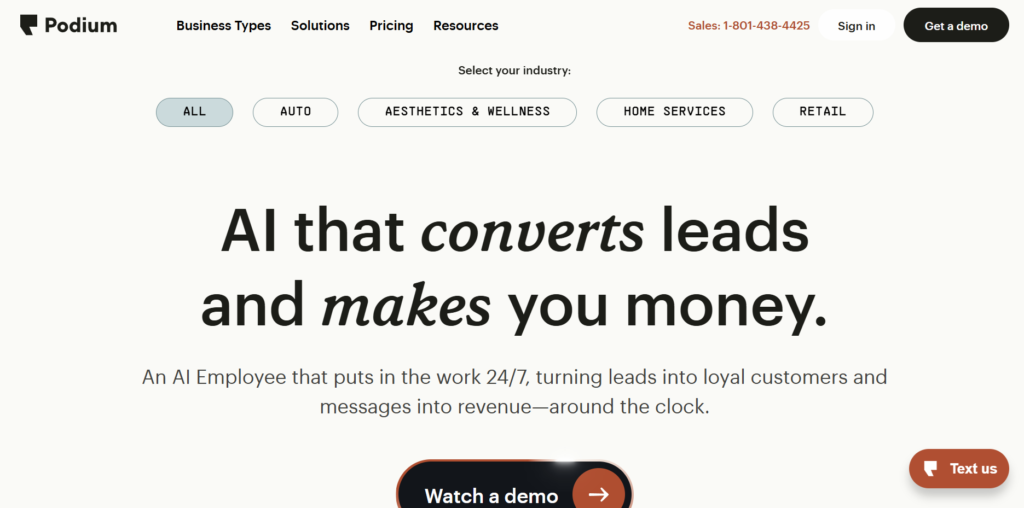
Best For: Service-based local businesses with 1-5 locations that prioritize lead conversion, customer messaging, and review generation over listing management. Podium is the strongest fit for automotive dealerships, home services companies (HVAC, plumbing), dental and medical practices, and retail stores where the speed of responding to inbound leads directly impacts revenue. It’s ideal for businesses that already have their listings managed elsewhere (or manually) and need a dedicated tool to turn those leads into conversations, reviews, and payments.
Podium is a customer communication and lead conversion platform that focuses on turning reviews, text messages, and phone calls into revenue. Unlike every other tool in this list, Podium is not primarily a listing management platform. Its strength is in what happens after a customer finds your business: the conversation, the review request, the payment, and the sale. Podium is built for service-oriented, customer-facing businesses that rely on inbound leads and local reputation.
Key Features
- AI Employee: Podium’s flagship feature. An AI-powered agent that engages with inbound leads, responds to inquiries, and guides customers toward actions like scheduling appointments or requesting quotes. The AI Employee is customized to your business with 40+ configurations and is trained on 10+ years of industry-specific conversation data. Available as an add-on to any base plan. Industry-specific versions include AI BDC (auto), AI Patient Coordinator (wellness), AI CSR (home services), and AI Sales Consultant (retail).
- Reviews: Sends automated review requests via SMS after customer interactions. Monitors and responds to reviews across Google and other platforms. AI-powered review responses with full control over which reviews are addressed automatically.
- Unified Inbox: Consolidates text messages, webchat conversations, social media messages, and phone interactions into a single inbox. Teams can manage all customer communication without switching between platforms.
- Webchat: A website chat widget that routes conversations to text messaging, so the conversation continues even after the customer leaves your site.
- Phones and Calling: A built-in business phone system with call recording, call summaries, call transfers, and AI-generated transcripts. Includes a softphone for making and receiving calls from the Podium app.
- Text Marketing: Bulk SMS campaigns for promotions, appointment reminders, and re-engagement. Includes text-based surveys for collecting customer feedback.
- Payments: Collects payments via text message links. Customers receive a secure payment page and can pay with a credit or debit card. Credit card processing fees vary by plan.
- Analytics: Tracks inbound leads, response times, total conversations, review invites sent, reviews collected, and average ratings. Includes a Location Leaderboard for multi-location businesses to compare performance across locations.
- Industry solutions: Purpose-built workflows for automotive (dealerships, used auto, auto body), aesthetics and wellness (med spas, dental), home services (HVAC, plumbing), and retail (jewelry, furniture, appliance, mattress).
- Mobile app: Full-featured mobile app for managing conversations, reviews, and payments on the go.
Pricing
Podium does not publish fixed prices on its website. All pricing is quote-based, meaning you must contact their sales team for a specific number. The platform offers three plan tiers:
- Core: Lead conversion platform with unified inbox, review management, basic AI features, basic automations, and up to 2 locations. Based on third-party verified data, the Core plan starts at approximately $399/month.
- Pro: Everything in Core plus advanced AI, expanded automations, and support for up to 5 locations. Approximately $599/month based on third-party data.
- Signature: Custom pricing for established, multi-location businesses. Contact sales for a quote.
Additional costs to be aware of:
- Podium Phones: $30/month per user (1-4 users) or $25/month per user (5+ users), plus a $500 network optimization fee per location
- Additional phone numbers: $5/month each
- 10DLC base fee (US locations): $5/month
- AI Employee: Available as an add-on, pricing varies by plan and customization
All plans include onboarding, support, and a resource center. Podium does not currently offer a publicly listed free trial.
Pros
- The AI Employee is one of the most advanced conversational AI tools for local businesses, with industry-specific training for auto, wellness, home services, and retail
- Text-first approach to customer communication matches how most consumers prefer to interact with local businesses in 2026
- Combines reviews, messaging, payments, and phone in a single platform, eliminating the need for separate tools for each
- Strong analytics with Location Leaderboard for multi-location businesses to benchmark performance
- Built-in payment collection via text reduces friction in the payment process
- Purpose-built industry solutions mean the platform is already configured for specific business types rather than requiring custom setup
- Mobile app allows full management of conversations and reviews from anywhere
Cons
- Not a listing management tool. If keeping your NAP data accurate across directories is your primary need, Podium is not a replacement for Yext
- Expensive. The Core plan starts at ~$399/month, and most businesses end up paying $500-$800/month after add-ons (phones, AI Employee, extra numbers)
- No public pricing creates friction in the evaluation process and makes cost comparisons difficult
- Annual contracts are standard, and multiple G2, Capterra, and Trustpilot reviewers report difficulty cancelling and continued billing after cancellation requests
- Limited to 2 locations on the Core plan and 5 on Pro, which may not fit larger multi-location brands without the Signature plan
- No listing sync, citation building, or directory management features
- No local rank tracking or SEO tools
- Some users report poor call quality and failed text message delivery without notification
How to Choose the Right Yext Alternative
With 9 tools covered in detail, picking the right one comes down to your business type, team size, and what you actually need. Here’s a quick decision framework based on four common scenarios.
If You’re a Single-Location Small Business
You don’t need an enterprise platform. You need accurate listings, a way to collect reviews, and a simple dashboard that doesn’t take hours to learn.
Best options:
- Moz Local Lite ($16/month annually) if your main goal is keeping your NAP data accurate across 90+ directories with minimal effort. It’s the cheapest automated listing sync tool available, and GeoRank maps are included even on the entry plan.
- BrightLocal Track ($39/month) if you also want local rank tracking, citation audits, and competitor insights alongside basic listing management. Upgrade to Grow ($59/month) when you need review management.
- Whitespark Listings Service (one-time fee starting at $20) if you want to build citations once and own them permanently without any recurring subscription.
Avoid: Birdeye, SOCi, Uberall, and Podium. These are priced for multi-location businesses and will cost far more than a single-location operation needs to spend.
If You’re an Agency Managing Multiple Clients
You need white-label reporting, multi-client management, scalable pricing, and tools your team can deploy quickly across accounts.
Best options:
- Synup ($79/month Startup plan for up to 25 client locations) if you want a full agency operating system with white-label dashboards, CRM, invoicing, proposals, churn forecasting, and client portals. No other tool matches Synup’s agency-specific feature set.
- BrightLocal Grow ($59/month per location) if you want a proven local SEO platform with white-label reports, citation building, local rank tracking, and review management. BrightLocal is the industry standard for SEO agencies managing local clients.
- Whitespark (à la carte pricing) if your clients primarily need citation building and rank tracking without a full platform subscription. The pay-per-service model keeps your margins healthy.
Avoid: SOCi (too expensive for most agencies), Podium (not a listing management tool), and Yext (per-location pricing will erode your margins at scale).
If You’re an Enterprise with 50+ Locations
You need centralized governance, bulk editing, compliance controls, AI automation, and a platform that can handle hundreds or thousands of locations without breaking.
Best options:
- Uberall if you operate internationally across Europe and North America and need 150+ directory integrations, localized landing pages, GDPR compliance, and AI search visibility monitoring through GEO Studio.
- SOCi if you’re a franchise or distributed brand that needs autonomous AI agents handling local search, social, and reviews at every location without manual intervention from location managers.
- Birdeye if your primary concern is review management and customer experience at scale, with 3,000+ integrations connecting to your existing CRM and operations stack.
When Yext is still the right answer: If you need 200+ directory integrations, a Knowledge Graph architecture, enterprise-grade PHI compliance for healthcare, and AI search visibility via Scout, Yext may still be the strongest fit at enterprise scale. The alternatives above beat Yext on price and usability, but Yext’s publisher network and compliance features remain hard to match for very large, complex deployments.
If Budget Is Your Main Concern
You want the most value for the least money. Here’s how the options stack up from cheapest to most expensive for a single location:
- Whitespark Listings Service: Starting at $20 (one-time). Build citations once, own them forever. No recurring fees.
- Whitespark Local Platform: $1/month per location for basic GBP management.
- Moz Local Lite: $16/month per location (annual billing). Automated listing sync across 90+ directories.
- Semrush Local Base: $30/month per location. GBP AI Agent with automated posts and review replies (no listing management at this tier).
- BrightLocal Track: $39/month per location. Rank tracking, audits, and competitor insights.
- Synup Startup: $79/month for up to 25 locations (works out to ~$3.16/location if you max it out).
The budget-friendly rule of thumb: If you need listings managed, start with Moz Local or Whitespark. If you need rank tracking and audits, start with BrightLocal. If you need reviews and customer messaging, you’ll need to spend more (Birdeye, Podium), but consider starting with BrightLocal’s Grow plan ($59/month) as a more affordable entry point for basic review management.
Common Mistakes When Switching from Yext
Choosing the right tool is only half the process. How you switch matters just as much. Here are four mistakes that businesses and agencies make regularly when moving away from Yext.
Choosing a Tool Only Based on Price
This is the most common mistake. A business sees Yext costing $500+/month, finds a tool at $39/month, and switches immediately without comparing feature coverage.
The problem is that lower-priced tools often cover a narrower set of directories, offer fewer integrations, or lack features your team actually uses (like review generation, social posting, or GBP management). If you switch to a cheaper tool and lose accurate listings across 100+ directories, the cost savings can be wiped out by lost local visibility and fewer customer actions.
What to do instead: List the specific features your team uses in Yext today. Then compare those features across alternatives. If you only use Yext for basic listing management on Google, Facebook, and Apple Maps, a tool like Moz Local at $16/month covers that. But if you rely on Yext for review management, social posting, local pages, and analytics across 200+ directories, you’ll need a more complete platform like Birdeye or Uberall to avoid losing functionality.
Not Auditing Existing Listings First
Many businesses cancel Yext and sign up for a new tool the same day, without checking the current state of their listings.
This is a problem because Yext uses a sync-based model. The moment your subscription ends, Yext stops pushing data to directories. Some listings will stay accurate. Others will revert to old data or disappear entirely. If you don’t know what your citation profile looks like before you cancel, you won’t know what needs fixing after.
What to do instead: Before cancelling Yext, run a full citation audit using a tool like BrightLocal’s free local search audit, Moz’s free citation checker, or Whitespark’s Local Citation Finder. Document every directory where your business is listed, check for NAP inconsistencies, and note which listings are manually claimed vs. Yext-synced. This gives your new tool (or your team) a clear cleanup checklist to work from after the transition.
Ignoring Google Business Profile as the Priority Channel
Some businesses spend weeks evaluating which tool syncs to the most directories, while their Google Business Profile is incomplete, unoptimized, or hasn’t been posted to in months.
Google Business Profile is the single most important local listing for almost every business. It directly influences your appearance in Google Maps, the local pack, and increasingly in AI-generated search results. No number of directory listings on smaller sites will compensate for a poorly optimized GBP.
What to do instead: Before switching tools, make sure your GBP is fully optimized. This means accurate business information, complete categories, high-quality photos, a keyword-informed business description, regular posts, and active review management. Tools like Semrush Local (GBP AI Agent), Whitespark (Local Platform at $1/month), and BrightLocal (GBP audit) all offer strong GBP-specific features. Pick a tool that prioritizes GBP management, not just broad directory distribution.
Switching Without a Migration Plan
Cancelling Yext and activating a new tool is not a migration plan. A real migration accounts for timing, listing ownership, data cleanup, and team onboarding.
Here’s what a proper migration plan looks like:
- Audit your current listings while Yext is still active (as described above).
- Claim key listings manually before cancelling. Manually claim your Google Business Profile, Facebook page, Apple Maps listing, and Yelp page using your own login credentials. These are the highest-impact directories and should never depend on a third-party tool’s access.
- Choose your new tool and set it up before cancelling Yext. Get your business data entered, directories connected, and team members onboarded.
- Cancel Yext once your new tool is live and actively syncing or your manual citations are submitted.
- Run a post-cancellation audit 30 days after cancelling Yext. Check for listings that reverted, disappeared, or show incorrect data. Use your new tool or a citation service (like Whitespark’s Listings Service) to clean up any issues.
- Monitor for 90 days. Listing data can take weeks to months to fully stabilize across directories after a platform switch. Set a reminder to re-audit at the 30, 60, and 90-day marks.
If you want to skip the complexity entirely, Whitespark’s Yext Replacement Service ($399 one-time per location) handles the full process: cancellation coordination, listing audit, cleanup, and new citation building.
Conclusion
The right Yext alternative depends on your business size, budget, and what you actually need.
For small businesses, Moz Local and BrightLocal offer the best value. For agencies, Synup and BrightLocal provide white-label tools that scale. For enterprise and franchise brands, Birdeye, Uberall, and SOCi handle listings, reviews, and social at scale. For teams already on Semrush, adding Semrush Local keeps everything under one roof. And for businesses that want to own their listings permanently without recurring fees, Whitespark is the clear choice.
Before you switch, audit your listings, claim your Google Business Profile manually, and have a migration plan ready. The right tool paired with a clean transition will put you in a stronger position than Yext at a lower cost.
FAQs
Whitespark’s Listings Service starts at $20 (one-time fee) for citation building with no recurring costs. For automated listing sync, Moz Local starts at $16/month per location on annual billing.
Not fully. Yext uses a sync-based model, so when you cancel, directories may revert to old data over time. A Whitespark case study found that 60% of listings disappeared or showed incorrect information after cancellation. To protect your data, manually claim your Google, Facebook, Apple Maps, and Yelp profiles before cancelling.
For most small businesses with 1-5 locations, no. Yext’s pricing starts at $199/year and scales quickly, and the platform is built for enterprise teams. Tools like Moz Local ($16/month) or BrightLocal ($39/month) cover the core listing and review management features small businesses need at a fraction of the cost.
Google Business Profile is the best free option. It lets you manage your listing on Google Search and Maps, respond to reviews, and publish posts at no cost. For free audits, BrightLocal and Moz both offer free citation checkers. For full directory distribution, paid tools starting at $16/month are required.
Choose Yext for 50+ locations needing 200+ directory integrations and enterprise compliance. Choose BrightLocal for 1-25 locations needing affordable rank tracking, citation building, and white-label reports. The key difference: BrightLocal’s citations are permanent. Yext’s listings require an active subscription.
Choose Yext if listing accuracy across the widest directory network is your top priority. Choose Birdeye if review management, customer messaging, and lead conversion matter more. Both are premium platforms, but Birdeye delivers faster ROI for businesses where online reviews directly drive revenue.
About the Author
I’m Shasi, the Founder of Citation Forge, with 10+ years of experience in Local SEO, local citation building, and overall, SEO. I’m passionate about helping businesses improve their online visibility, Google Business Profile rankings, and local search presence through effective SEO and citation strategies. Over the years, I’ve worked with businesses and agencies worldwide, helping them build stronger online authority and long-term organic growth. I also enjoy writing about SEO, Local SEO, local citations, link-building, and digital marketing to share practical insights, strategies, and industry updates that help businesses grow online more effectively.