I work with dental practices every week, and one thing is always clear. Local SEO for dentists is one of the most reliable ways to bring in new patients from Google.
Local SEO focuses on helping your dental practice appear when people nearby search for services like “dentist near me,” “emergency dentist,” or “family dentist in your city.” If your practice does not show up for these searches, potential patients will choose another dentist instead.
For dentists, Google Maps matters more than traditional SEO. When someone searches for a local dentist, Google usually shows a map with three practices at the top of the page. These listings get the most attention, the most clicks, and the most calls. Ranking a blog post alone will not bring the same results as appearing in Google Maps when a patient is ready to book an appointment.
In this guide, I explain how local SEO works specifically for dental practices and what actually helps dentists rank higher in Google Maps.
You will learn how to optimize your Google Business Profile, earn and manage patient reviews, improve your website for local searches, and build trust signals that Google looks for when ranking dentists.
What Is Local SEO for Dentists (And Why It Drives New Patients)
Local SEO for dentists is about showing your practice to people who are actively looking for a dentist in your area. It focuses on local search results, especially Google Maps, instead of trying to rank pages nationally. When done right, dentist local SEO helps your practice appear at the exact moment a nearby patient is ready to book an appointment.
For dental practices, local SEO is one of the strongest patient acquisition channels because it targets people with immediate intent. Someone searching locally is not researching for fun. They usually need care now or soon.
How Local SEO Works for Dental Practices
Local SEO works differently than general SEO. Traditional SEO focuses on ranking blog posts or service pages across a wide region or even nationwide. Local SEO for dental practices focuses on visibility within a specific city, neighborhood, or service area.
Google looks at a mix of signals to decide which dentists show up in local results, especially in Google Maps. The most important signals include:
- How complete and accurate your Google Business Profile is
- How relevant your services are to the search
- How close your practice is to the searcher
- How trusted your practice appears based on reviews and online mentions
- How well your website supports local search intent
Local search optimization for dentists is not about chasing keywords alone. It is about proving to Google that your practice is real, trusted, and relevant for people searching in your location.
Why “Dentist Near Me” Searches Matter
“Dentist near me” searches are some of the highest-intent searches in healthcare. When someone types that phrase into Google, they are usually looking for immediate care, not information.
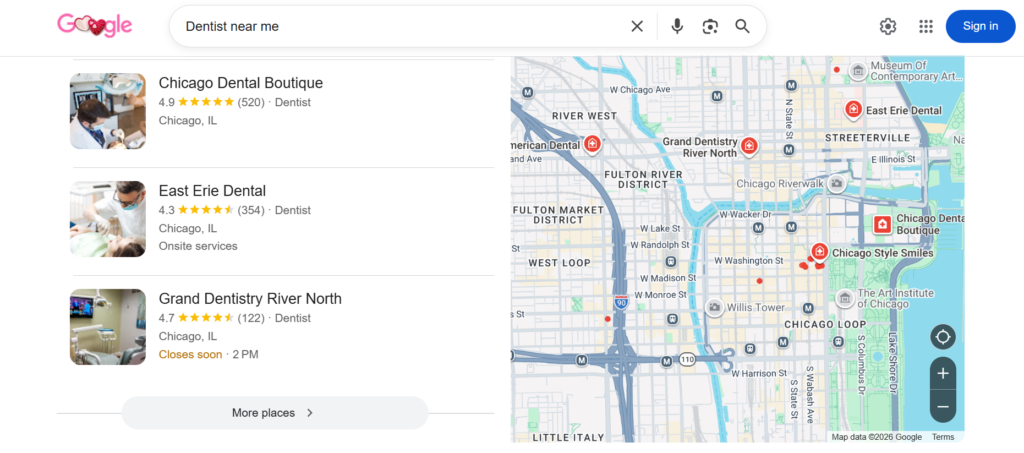
Google responds to these searches by showing the Map Pack, which includes three local dental practices above the regular search results. These listings attract the most attention, the most clicks, and the most phone calls.
Dentist near me SEO matters because Google uses three core signals to rank these listings:
- Proximity: How close the practice is to the searcher
- Relevance: How well the listing matches the service being searched
- Trust signals: Reviews, consistency, and overall online presence
When your dental practice is optimized for local search, you increase your chances of showing up in the Map Pack and being chosen by patients who are ready to book. That is why local SEO drives new patients more reliably than broad, traditional SEO for most dental practices.
Also Read: Google Local Pack SEO: What It Is & How to Rank [Complete Guide]
How Google Ranks Dentists in Google Maps
If you want to improve dentist Google Maps ranking, you need to understand how Google decides which practices appear in the Map Pack. Many dentists jump straight into tactics without understanding the ranking logic. That usually leads to wasted effort.
Google uses a local ranking system that is different from traditional SEO. It focuses on signals that help Google match nearby patients with the most relevant and trustworthy dental practices.
The Three Core Local Ranking Factors
Google has clearly stated that local rankings are based on three main factors. Every local map pack for dentists is built using these signals.
Relevance
Relevance measures how well your dental practice matches what someone is searching for. Google looks at your business categories, listed services, website content, and profile details to decide if your practice fits the search. If your Google Business Profile does not clearly show what services you offer, Google is less likely to show you.
Distance
Distance refers to how close your practice is to the person searching. You cannot change your physical location, but distance still plays a role in every search. This is why local SEO focuses on visibility within realistic service areas instead of trying to rank everywhere.
Prominence
Prominence is about trust and authority. Google looks at how well known your practice appears online. Reviews, mentions, backlinks, and consistent business information all contribute to prominence. Practices with stronger trust signals often outrank competitors even when they are slightly farther away.
Understanding these three factors is essential if your goal is to rank dentist on Google Maps consistently.
What Dentists Can Actually Control
While you cannot control distance, you can influence most of the signals that affect local rankings. This is where smart local SEO work makes a real difference.
Profile optimization
Your Google Business Profile is the foundation of local rankings. Accurate categories, detailed services, correct contact information, and regular updates help Google understand your practice and improve relevance.
Reviews
Reviews affect both prominence and click behavior. A steady flow of genuine patient reviews shows Google that your practice is trusted and active. Responding to reviews also reinforces engagement and professionalism.
Website signals
Your website supports your Maps listing. Clear service pages, local keywords, location information, and strong conversion elements help Google connect your site to your local presence.
Local authority
Local authority comes from citations, links, and mentions from trusted local and dental-related sources. These signals help Google confirm that your practice is legitimate and established in your area.
When dentists focus on what they can control instead of chasing shortcuts, Google Maps rankings become far more predictable and sustainable.
Also Read: 15 Benefits of Local SEO That Help You Get More Local Customers
Google Business Profile Optimization for Dentists (Most Important Step)
When I audit local SEO dentist performance, I start with Google Business Profile almost every time. Your profile is what powers your Google Maps visibility, your Map Pack placement, and a big chunk of your calls and appointment clicks.
Google also has strict rules for what you can and cannot do inside your profile, so getting the basics right matters as much as the extras.
Setting Up Google Business Profile the Right Way
A solid setup keeps you compliant and helps Google trust your listing.
Business name rules
Use your real-world business name, exactly how patients see it on signage and your website. Avoid adding extra keywords like “best dentist,” “cheap,” or a list of services in the name field. Google’s guidance is clear that your profile should reflect how your business is represented in the real world, and spammy names can lead to edits or other issues.
Address and service area
If patients visit your office, use your precise physical address. Make sure it matches what you use everywhere else online. Google also recommends keeping your address and service area accurate and precise. For most dental practices, the service area is secondary to the actual office location, since you want patients driving to your clinic.
Phone and appointment links
Use a phone number that connects to your front desk, and add an appointment link that goes to a booking page patients can use on mobile. From an SEO standpoint, it helps when Google can see clear paths from listing to conversion. Even better when your appointment URL matches the exact location and provider.
Choosing the Right Categories and Services
Categories are one of the strongest relevance signals in google business profile for dentists optimization. Google states that categories help connect your business with customers who search for what you offer, so picking the right ones matters.
Primary category: Dentist
In most cases, your primary category should be Dentist. I only change that if the practice is clearly positioned as something else (for example, a clinic that only does orthodontics).
Secondary categories based on services
Add secondary categories that match your real services and your revenue drivers. Common examples include:
- Cosmetic Dentist
- Pediatric Dentist
- Emergency Dental Service
- Orthodontist
- Dental Implants Periodontist (only if accurate to the practice)
Keep it tight. Google recommends using the fewest number of categories needed to describe your core business.
Also, fill out your Services list so Google and patients can clearly see what you offer. That supports relevance for searches beyond “dentist near me.”
Optimizing Photos, Posts, and Q&A
This is where a lot of dentists fall behind. A profile can be technically correct but still look weak compared to competitors.
What types of photos convert
I recommend adding a mix that answers patient concerns fast:
- Exterior photos (helps patients find the building)
- Reception area and treatment rooms (reduces anxiety)
- Staff photos (adds trust)
- Equipment and cleanliness shots (signals professionalism)
High-quality, current photos also make your listing look active, which improves engagement.
Posting frequency
Use Google Posts to share offers, reminders, and updates like:
- New patient specials
- Same-day emergency availability
- Insurance updates
- Seasonal checkup reminders
A simple cadence works well, like one post per week. Consistency matters more than volume.
Using Q&A to pre-sell trust
The Q&A section is a quiet conversion booster. I like to seed the most common patient questions, then answer them clearly:
- Do you take my insurance?
- Do you offer emergency appointments?
- Do you offer sedation dentistry?
- What are your hours on weekends?
Clear answers reduce friction and can increase calls.
Common GBP Mistakes Dentists Make
These are the problems I see most often when someone asks me why they cannot rank higher in Google Maps.
- Keyword stuffing: Stuffing keywords into your business name, description, services, or posts can backfire. It can lead to ranking drops or even profile suspension in serious cases. Keep wording natural and accurate.
- Wrong categories: Choosing categories that do not match your actual services confuses Google and patients. Categories should reflect your real offering, not what you wish you ranked for. Google directly ties categories to how customers discover you on Search and Maps.
- Ignoring profile updates: Leaving your profile stale is a common mistake. Outdated hours, missing services, no new photos, and no posts can make your practice look inactive. Regular updates support trust and performance over time.
How Reviews Impact Local SEO for Dentists
When I’m working on dentist reviews SEO, I look at reviews as two things at the same time.
- A ranking signal that can help you show up higher in Google Maps
- A conversion asset that helps a patient choose you over the dentist down the street
That’s why google reviews for dentists are one of the highest-leverage parts of local SEO. Google has even stated that “more reviews and positive ratings” can improve a business’s local ranking.
Why Google Reviews Matter for Dentist SEO
Google reviews for dentists influence both where your practice ranks and how often patients choose you. From my experience, reviews are one of the few local SEO factors that impact rankings and patient behavior at the same time.
They influence Google Maps rankings
Reviews are part of “prominence,” which is one of the core factors Google uses to rank local businesses. In plain English, prominence is how trusted and well-known your practice looks online. Google specifically calls out reviews as part of what can improve local rankings.
In dental, this matters even more because so many practices in the same area offer similar services. Reviews can be the difference between ranking #2 and not showing up in the Map Pack at all.
They drive click-through behavior
Even if you rank well, patients still choose who to contact. Most people scan the Map Pack fast. They look at your star rating, review count, and recent feedback before they click or call. A strong rating plus a healthy review count usually wins the click.
They build trust for healthcare searches
Dental is a trust-first decision. Patients worry about pain, cost, bedside manner, and cleanliness. Reviews answer those concerns better than any marketing copy on a website. That trust increases calls, bookings, and form fills once you show up.
How to Get More Reviews Without Violating Guidelines
I’m big on doing this the safe way. You want more reviews, but you do not want to risk having reviews removed or triggering profile issues.
Use ethical review requests
The clean approach is simple:
- Ask every patient, not just the happiest ones
- Do not offer discounts, gifts, or incentives for reviews
- Do not block unhappy patients from leaving reviews (review gating)
Google’s policies and review systems are designed to detect patterns of manipulation, and content can be removed if it violates their rules.
Use timing and a simple system
The best timing is right after a positive moment:
- After a successful cleaning
- After pain relief in an emergency visit
- After a patient compliments the team
- After a treatment plan is completed
The system I like most is basic and repeatable:
- Front desk confirms the patient’s phone or email at checkout
- Automated text or email goes out within a few hours
- The link goes straight to your Google review page
- One polite follow-up if they do not leave a review
Consistency beats volume. A steady flow of recent reviews looks more natural and tends to perform better over time.
How to Respond to Reviews the Right Way
Responding helps with reputation and can help future patients feel comfortable. It also shows your practice is active and attentive.
One big warning for dentists, protect patient privacy. The American Dental Association has pointed out that dentists should keep privacy in mind when responding to online reviews, since HIPAA and other privacy laws can apply.
How to respond to positive reviews
Keep it short, warm, and general. I recommend:
- Thanking them
- Reinforcing the type of experience you want to be known for
- Inviting them back
Example approach (keep it general):
“Thanks for the kind words. We’re happy you had a comfortable visit. We appreciate you trusting our team.”
How to respond to negative reviews
Negative reviews are not the end of the world, but your reply matters. I suggest:
- Stay calm and professional
- Do not confirm they are a patient
- Offer a way to talk offline
- Avoid details about treatment or billing in public
Example approach (privacy-safe):
“We’re sorry to hear you had a frustrating experience. We take feedback seriously. Please call our office so we can look into this and help.”
Handled the right way, negative reviews can actually build trust because patients see you respond like a professional.
On-Page Local SEO for Dentist Websites
Your website still matters for local rankings, even if Google Maps brings most of the visibility. Strong on page SEO for dentists helps Google connect your website to your Google Business Profile and reinforces relevance, trust, and location signals. It also plays a big role in turning visitors into actual patients.
I look at on-page optimization for dental sites with two goals in mind. Support Map Pack rankings and make it easy for patients to contact you.
Optimizing Service Pages With Local Keywords
Service pages are the backbone of seo for dentist website performance. Each core service should have its own page that clearly explains what you offer and where you offer it.
City + service targeting
Local pages work best when they focus on one service and one location. Examples include:
- Teeth whitening in Austin
- Emergency dentist in Phoenix
- Dental implants in Chicago
Mention your city naturally in the page copy, headings, and supporting content. Avoid forcing it into every sentence. Google looks for clarity, not repetition.
Title tags and headings
Your title tag and main heading help Google understand page relevance fast. I recommend:
- Title tag: Primary service + city
- H1 heading: Clear service name with location context
For example, a title tag like “Emergency Dentist in Dallas | Same-Day Appointments” supports both local SEO and clicks.
Location Pages for Multi-Location Dental Practices
If your practice has more than one office, location pages are essential for dentist location pages seo.
When you need them
You should create separate location pages if:
- You have multiple physical offices
- Each location has its own address and phone number
- Patients book appointments at specific offices
Avoid creating location pages just to target nearby cities where you do not have an office. That often leads to weak pages and ranking issues.
What to include
Each location page should stand on its own and include:
- Full practice name, address, and phone number
- Office hours
- Embedded Google Map
- Services offered at that location
- Photos of the actual office and team
- Directions and parking details
Unique content is important. Copying the same text across locations weakens dental website local seo and can limit performance.
Conversion Elements That Turn Traffic Into Patients
Ranking means very little if patients cannot contact you easily. I treat conversion optimization as part of local SEO, not a separate task.
Click-to-call
Mobile users make up a large share of local dental searches. Make sure your phone number is:
- Clickable on mobile
- Visible near the top of the page
- Consistent with your Google Business Profile
Online booking
If you offer online scheduling, link to it clearly from service and location pages. Patients often prefer booking without calling, especially outside office hours.
Trust signals
Trust reduces hesitation. I recommend adding:
- Google review snippets
- Dentist credentials and memberships
- Before-and-after photos when appropriate
- Clear insurance and payment information
When your website supports both rankings and conversions, it strengthens your overall local SEO and helps turn visibility into real patient growth.
Local Citations and NAP Consistency for Dentists
Local citations help Google confirm that your dental practice is real, established, and trustworthy. When done correctly, dentist local citations support Google Maps visibility and strengthen the trust signals behind your listing. When done poorly, they create confusion and can hold rankings back.
I look at citations as a foundation task. They do not create fast spikes, but they support everything else in dental website local seo.
What NAP Consistency Means for Dental Practices
NAP stands for Name, Address, and Phone number. NAP consistency for dentists means your practice information appears exactly the same across your website, Google Business Profile, and every directory listing online.
Even small differences can cause problems, such as:
- “Suite” vs “Ste”
- Old phone numbers
- Slight name variations
- Moved locations that still show online
Google uses this data to confirm business identity. When information conflicts, Google becomes less confident about which listing is accurate. That can weaken trust and reduce visibility in local results.
From my experience, fixing NAP issues alone has helped some dental practices stabilize rankings that were bouncing around without explanation.
Also Read: Local Citation Mistakes: 7 Common Errors That Hurt Your Local SEO Rankings
Best Citation Sources for Dentists
Not all citations carry the same value. I focus on accuracy and relevance, not volume.
General directories
These are the core platforms Google expects to see:
- Google Business Profile
- Yelp
- Apple Maps
- Bing Places
These platforms influence discovery and trust, and they often feed data into other systems.
Dental-specific directories
These help reinforce topical relevance:
- Healthgrades
- Zocdoc
- WebMD
- RateMDs
- ADA Find-a-Dentist
Listings on dental business directories help confirm that your practice operates in the healthcare space, not just as a generic local business.
Local business listings
Local citations show geographic relevance:
- Chamber of Commerce listings
- Local business associations
- City or neighborhood directories
- Sponsorship or community organization pages
These local listings for dentists support prominence and location trust, especially in competitive areas.
Cleaning Up Duplicate or Incorrect Listings
Citation cleanup is often more important than building new listings. I see many dental practices with:
- Duplicate listings from past moves
- Old phone numbers from previous tracking systems
- Listings created automatically by data aggregators
Here is how I approach cleanup:
- Audit existing listings for accuracy
- Claim or request edits on incorrect profiles
- Remove duplicates when possible
- Update information so it matches your Google Business Profile exactly
This process improves clarity for Google and reduces mixed signals. Once your citations are clean and consistent, your other local SEO efforts work more effectively.
Also Read: How to Audit Your Existing Local Citations (Step By Step)
Local Content That Helps Dentists Rank and Convert
Local content supports rankings long term and helps patients feel confident choosing your practice. A smart dental SEO content strategy does more than chase traffic. It answers real patient questions, supports Google Maps relevance, and builds topical authority around your services and location.
I treat content as a supporting system for local SEO, not a blogging exercise for vanity metrics.
Blog Content Ideas for Local Dentist SEO
The best local content for dentists comes directly from what patients ask every day. When your site answers those questions clearly, Google learns what your practice is known for.
Patient questions
These topics work well for dentist blog SEO and often convert visitors:
- Does a root canal hurt?
- How often should I get a dental cleaning?
- What should I do for a toothache at night?
- How much does a dental implant cost?
Answer questions honestly and simply. Use plain language and explain options. These posts help attract search traffic and prepare patients before they call.
Emergency and specialty services
Service-focused content helps with high-intent searches. Examples include:
- Emergency dentist services in your city
- Same-day dental care
- Cosmetic dentistry options
- Dental implants and restorative care
These pages and posts support local keywords for dentists that people search when they need treatment soon, not months later.
Location-Based Content That Makes Sense
Location content works best when it adds value instead of repeating the same page for every nearby city.
City and neighborhood relevance
Good location-based content can include:
- Serving specific neighborhoods or communities
- Directions and parking guidance
- Local insurance plans you commonly accept
- Community involvement or sponsorships
Mentioning real locations and local details helps Google connect your practice to the area in a natural way.
Avoiding thin content
Thin pages hurt more than they help. Avoid:
- Creating pages for cities where you do not have an office
- Swapping city names while keeping the same text
- Publishing short pages with no real information
Every page should answer a real patient need. When content is useful, rankings and conversions tend to follow.
Over time, consistent local content builds authority around your services and location. That authority supports Google Maps visibility and helps turn search traffic into scheduled appointments.
Local Link Building Strategies for Dentists
If you want stronger local SEO optimization for dentists, you need local authority. And one of the cleanest ways to build that authority is earning links from real local websites that people in your community already trust.
Links are not about chasing volume. They are about getting the right signals from the right places. Google’s local rankings lean on relevance, distance, and prominence. Links support prominence by showing that other trusted sites recognize your practice.
Local Links That Actually Help Dentist SEO
These are the link types I’ve seen work best for dental practices because they are natural, local, and easy to justify.
Sponsorships
Sponsor something your community already cares about, then get a link from the organizer’s website. Examples:
- Youth sports teams
- School events
- Local charity fundraisers
- 5Ks and community runs
Most event sites have sponsor pages, and many include a logo and a link back to your dental practice site. This is one of the safest link plays because it is based on real involvement, not SEO tricks.
Local partnerships
Partner with businesses that serve the same audience but do not compete with you. A few that work well:
- Pediatricians and family medicine offices
- Orthodontists (if you do not offer ortho)
- Physical therapy clinics
- Gyms and wellness studios
- Daycares and schools
The best approach is simple: set up a referral relationship or co-host a local offer, then earn a link from their partner page, resources page, or blog.
Community involvement
Community involvement creates links and trust at the same time. If you:
- host a free dental education event
- participate in a local health fair
- donate to a local cause
You can often earn links from city sites, community calendars, local news, and nonprofit sites. It also builds brand familiarity, which helps when patients compare dentists in the Map Pack.
What to Avoid
I’m going to be direct here. The wrong links can hurt your site, and Google is very clear about link spam and manipulative link practices.
Paid spam links
Avoid paying for links that exist only to influence rankings. This includes:
- paid guest posts on unrelated sites
- “DA-based” link packages
- private blog network links
- bulk link blasts
Google’s spam policies cover link schemes, and paid links meant to manipulate ranking can put your site at risk.
Irrelevant directories
Not every directory helps. Skip:
- low-quality directories with no real traffic
- directory sites that list every business type in every city
- “SEO directory” networks built only for link selling
For dentists, citations matter, but links from junk directories do not build real authority. Focus on credible local and healthcare-relevant sites instead.
Quick note: if you’re considering dental SEO services, ask the agency to show you the exact types of links they build. If the answer sounds like “we have a network,” that is usually a red flag.
Also Read: Local Citations vs Backlinks: What’s the Difference?
How Long Local SEO Takes for Dentists (And What to Expect)
One of the first questions I hear from practice owners is, “How long does local SEO for dentists take?” That’s a fair question, because you’re not doing this for traffic. You’re doing it for calls, booked appointments, and new patients.
The honest answer is that timelines vary based on competition, your current online presence, and how much work needs to be cleaned up. But there are reliable benchmarks you can plan around.
Typical Timeline for Google Maps Improvements
Some changes can show up fast, and others take time to compound.
Short-term (days to a few weeks):
- Google Business Profile edits can be approved quickly, but Google notes some edits may take up to 30 days to review.
- Cleaning up basic issues like incorrect hours, categories, or missing services can improve engagement signals quickly.
Mid-term (1 to 3 months):
- This is when I typically see clearer movement in local rankings after consistent profile work, review activity, citation cleanup, and on-page updates. BrightLocal also notes that time is needed for search engines to recognize and index changes, and that timelines depend on competition and the current state of your site and listings.
Longer-term (3 to 6 months):
- This is the window when many practices start seeing more consistent Map Pack visibility and more predictable lead flow, assuming the work is done correctly and kept up.
What Early Wins Look Like
Early wins usually show up in “engagement” before you see big ranking jumps.
Here’s what I look for first:
- More calls and website clicks from your Google Business Profile
- More direction requests in Maps
- More impressions for searches tied to your services
- Your practice starting to appear for more keyword variations, not just your practice name
This is a good sign your local signals are getting stronger, even if you are not top 3 yet.
Why Consistency Matters
Local SEO is not a one-time setup. It is a system.
Google Maps rankings respond best when you keep sending steady trust signals over time:
- New reviews coming in consistently
- Regular profile activity (photos, posts, Q&A)
- Accurate listings across the web
- A website that stays aligned with what your profile claims
If you do a burst of work and stop, competitors who stay consistent often pass you. That’s why dentist SEO local works best when you commit to steady improvements, not quick fixes.
DIY vs Hiring Local SEO Services for Dentists
This is the point where many dentists pause and try to decide what makes the most sense for their practice. Should you handle local SEO yourself, or should you hire help? I have seen both approaches work, and I have also seen both fail. The difference usually comes down to time, competition, and expectations.
Local SEO is not difficult to understand, but it does require ongoing attention. That is why this decision matters more than most dentists realize.
When DIY Makes Sense
Handling local SEO on your own can work if your situation is fairly simple. If your practice is in a smaller market or a less competitive area, you can often make solid progress by focusing on the basics. Keeping your Google Business Profile accurate, asking patients for reviews, and making sure your website clearly explains your services and location can go a long way.
DIY also makes sense if you have time to stay consistent. Local SEO is not something you set up once and forget. Google responds better when your profile stays active, your reviews continue to come in, and your information stays accurate everywhere online. Dentists who enjoy learning and can commit time each week often do fine managing their own local SEO.
Where DIY usually breaks down is when daily responsibilities take over. SEO work gets pushed aside, updates stop, and competitors who stay consistent slowly move ahead.
When Hiring a Dentist SEO Company Is Smarter
Hiring local SEO services for dentists becomes the smarter choice when growth is a priority or competition is strong. In busy cities or dense suburbs, ranking in Google Maps often requires more than basic optimization. It takes experience, testing, and ongoing adjustments.
A reputable dentist SEO company already understands how Google Maps rankings behave in competitive markets. They know how to optimize Google Business Profiles correctly, build reviews without crossing policy lines, clean up citation issues, and strengthen website signals that support local rankings. Most importantly, they do this consistently, which is hard to maintain when SEO is not your main job.
Professional dental SEO services also make sense if you run multiple locations or want predictable patient growth. Managing reviews, listings, content, and links across several offices quickly becomes time-consuming. In those cases, outsourcing often saves money in the long run because mistakes and delays are avoided.
One piece of advice I always give is to ask very specific questions before hiring. Ask how they handle Google Business Profile compliance, what types of links they build, and how they track local results. Clear, direct answers usually indicate real experience. Vague explanations usually do not.
In the end, the right choice depends on your goals. DIY works when time is available and competition is light. Hiring help works when consistency, speed, and growth matter more.
Local SEO Checklist for Dentists (Quick Recap)
This checklist brings together everything that supports strong local visibility and patient growth. I use this same structure when auditing dental practices because it aligns closely with how Google evaluates local businesses.
Do Keyword Research
Every local SEO effort starts with understanding how patients search. You need to know which services people look for in your area and how they phrase those searches. Focus on service plus location terms, emergency-related searches, and common treatment names. This keyword research guides how you structure your website pages, Google Business Profile services, and content.
Create and Optimize a Google Business Profile
Your Google Business Profile is the foundation of local SEO. It should be claimed, verified, and fully completed with accurate business information. Use the correct primary and secondary categories, list your services clearly, upload current photos, and keep office hours updated. Regular activity signals to Google that your practice is active and reliable.
Optimize Your Website (On-Page Optimization)
Your website needs to reinforce what your Google Business Profile claims. Service pages should clearly explain what you offer and where you offer it. If you have multiple locations, each office should have its own location page with unique, useful information. Phone numbers, booking options, and trust elements should be easy to find on every important page.
Technical SEO
Technical issues can quietly limit performance, even if everything else looks good. Your site should load quickly, work well on mobile devices, and be easy for search engines to crawl. Clean site structure, proper indexing, and secure browsing all help support local rankings and user experience.
Reviews
Reviews should be part of an ongoing process, not a one-time push. Ask patients consistently, follow Google’s guidelines, and respond professionally. Recent, authentic reviews improve visibility and help patients feel confident choosing your practice.
Build Local Citations and Backlinks
Your business information should be consistent across major platforms, dental directories, and local business listings. Clean up duplicates and outdated listings. Beyond citations, earn local backlinks through community involvement, partnerships, and sponsorships. These signals help build local authority and trust.
Content
Local content helps with long-term growth. Focus on answering real patient questions, explaining treatments, and covering emergency or specialty services you offer. Content should always serve a purpose. Thin or repetitive pages tend to hurt more than help.
Track and Analyze Your Results
Local SEO should be measured, not guessed. Track calls, clicks, direction requests, and keyword visibility in Google Maps. Watch trends over time instead of daily fluctuations. This data tells you what is working and where adjustments are needed.
When these pieces work together, local SEO becomes far more predictable. You do not need to do everything at once, but you do need to stay consistent. That consistency is what helps Google trust your practice and helps patients choose you.
Conclusion
Local SEO for dentists works best when you treat it as a system, not a set of shortcuts. There are no tricks that consistently keep a dental practice ranking in Google Maps. What works is doing the fundamentals well and keeping them in place over time.
When you focus on the things that actually influence rankings, results become more predictable. A well-optimized Google Business Profile, steady patient reviews, a clear and trustworthy website, consistent business information, and useful local content all support each other. When one piece is weak, the whole system suffers. When they work together, Google has a much easier time trusting your practice.
If you are serious about getting more patients from local search, put your attention on what moves rankings and drives calls. Stay consistent, track what is working, and make improvements based on real data, not guesswork.
Local SEO is not about chasing trends. It is about building a strong local presence that patients and search engines can rely on. Done right, it becomes one of the most dependable ways to grow a dental practice through Google.
FAQs About Local SEO for Dentists
The cost of local SEO for dentists depends on how competitive your area is and how much work needs to be done. In smaller markets, costs are usually lower because fewer practices are competing for Google Maps visibility. In larger cities, prices tend to be higher because ranking requires more ongoing effort.
From what I see across the industry, dentists often spend anywhere from a few hundred dollars per month for basic support to several thousand dollars per month for full local SEO management. That usually includes Google Business Profile work, review strategy, website optimization, citations, and tracking.
The most important thing is not the price. It is what is included. Cheap services that focus on shortcuts often create problems later. Solid local SEO focuses on accuracy, consistency, and long-term results.
Yes, it is possible to rank in Google Maps without a website, but it puts you at a disadvantage. Google Business Profile alone can help you appear for branded searches and some local queries, especially in low-competition areas.
However, a website gives Google more signals to work with. It helps explain your services, location, and credibility in more detail. It also gives patients a place to learn about your practice before they call. In competitive markets, dentists with strong websites usually outperform those without one.
If your goal is steady growth and not just minimal visibility, having a website is strongly recommended.
There is no fixed number of reviews that guarantees top rankings. Google looks at several factors at once, including review quality, recency, and consistency. A practice with fewer but recent and authentic reviews can outperform one with many old reviews.
What matters most is keeping reviews coming in at a steady pace. Patients also pay attention to how recent your reviews are and how you respond to them. From a trust perspective, a practice with active feedback usually feels safer to choose.
Instead of chasing a specific number, focus on building a simple system that asks every patient for feedback and follows Google’s guidelines.
About the Author
I’m Shasi, the Founder of Citation Forge, with 10+ years of experience in Local SEO, local citation building, and overall, SEO. I’m passionate about helping businesses improve their online visibility, Google Business Profile rankings, and local search presence through effective SEO and citation strategies. Over the years, I’ve worked with businesses and agencies worldwide, helping them build stronger online authority and long-term organic growth. I also enjoy writing about SEO, Local SEO, local citations, link-building, and digital marketing to share practical insights, strategies, and industry updates that help businesses grow online more effectively.